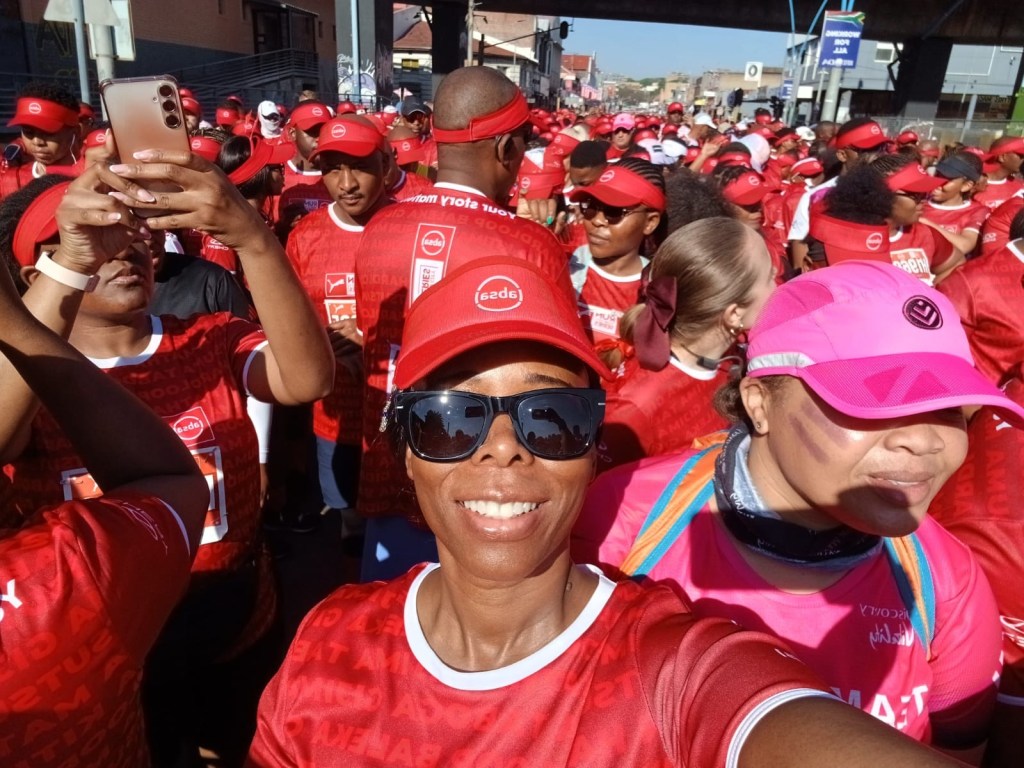
Yesterday, on Heritage Day, I completed the 10 km Absa Run Your City Joburg race in one hour and 48 minutes. I had hoped to finish within two hours. What I had not expected was how much the city and the people moving through it would stay with me.
The last time I took part, I began questioning my decision around the 4 km mark. The excitement of walking through downtown Johannesburg, taking photographs and being part of a crowd of some 15,000 people had worn off. My feet still had a long way to go.
Why had I signed up? Partly because the race offered something rare: a chance to walk the streets of Johannesburg with my phone in my hand and feel safe. On an ordinary day, that level of security is absent from this beautiful city of contradictions, with its crime and grime and its unexpected islands of community.
This year I came prepared. I paced myself and made finishing my goal. I am now over 50 and living with diabetes, for which I use insulin. I worried about having a medical emergency, so I took extra care to manage my blood glucose levels. During the week before the race, I walked, rested and made sure I wore comfortable shoes.
The race was well organised, with police escorts, closed roads, marshals and entertainment along the route. Yet it was the small moments that took my breath away.
An elderly woman moved steadily just ahead of me. She stopped to walk only once, then disappeared into the crowd. I watched her and thought: I want to be able to finish a 10 km race when I reach her age.
Crossing the Nelson Mandela Bridge was a rare pleasure. I looked down at the railway lines, the trains and parked carriages below, and realised I had already reached the first kilometre. At 3 km, cheerleaders dancing to music from loudspeakers gave me just the lift I needed for the climb up the off-ramp onto the freeway.
From the freeway, I could see the early finishers crossing the line at Mary Fitzgerald Square about 30 minutes into the race. It was a sobering sight when I still had so far to go, but also a celebration of what people can do.
Drivers in hundreds of cars and trucks passed in the opposite direction, waving, greeting us and sounding their horns. Strangers became our cheering section. Along the route, people on the sidewalks called out encouragement too.
There were stories unfolding among the participants. A couple ran side by side, paused, challenged each other and sprinted forward together. My husband is a runner and I am not. The last time we did this race, I let him run ahead, and that was okay. Watching this couple reminded me that partnership can make room for different paces.
Families brought their children. One father carried his son on his shoulders for 6 km, then let him walk the rest of the way. I was struck by how much energy children have when we give them the opportunity to use it. Another father pushed a baby in a pram. A woman said she had jokingly asked him for a ride, and they had laughed together.
Friends kept each other going. Some women ran hand in hand; others walked together and offered encouragement. One poured a cup of water down her friend’s back and announced, “She’s not running, she’s walking!” A gentleman remarked that perhaps we eat a little too well. I laughed because he had a point.
Then a group from Harriers Athletics Club ran past carrying signs against gender-based violence. Their speaker was playing “Asiphelelanga” by Vusi Nova and Jessica Mbangeni, lamenting beloved celebrities who have passed on. With the recent news of women’s dead bodies being found in Ekurhuleni, the song and the message met me in that moment. If that wasn’t the universe talking, I don’t know what was.
The route took us onto the M2, past Faraday Taxi Rank and Kwa Mai Mai market, where traditional healers sell herbs, animal skins and medicines, and where people gather for a meal at the popular outdoor restaurant. These places are part of Johannesburg’s living heritage, and moving past them on foot made me see them afresh.
At the 7 km mark, on the Anderson Street off-ramp, performers played while some participants stopped to dance. Even with the finish line still ahead, people found time to celebrate.
My crowning moment came after 8 km, as I passed the Absa offices on Main Street. The DJ played “All I Do Is Win.” I heard the song and knew I had made it. I crossed the line in 1:48, well within my two-hour goal.
I went into the race wanting to finish safely. I came away remembering the woman ahead of me, the children, the friends, the music, the waving drivers and the strangers who cheered us on. For a few hours, the streets of Johannesburg belonged to all of us. It was a beautiful way to celebrate Heritage Day and the start of the African New Year.











You must be logged in to post a comment.