There’s a quiet war being fought every day—a spiritual battle that unfolds not just in temples or sacred rituals, but in our thoughts, our actions, and the intentions we carry. Whether you light a candle, pour water for a blessing, burn incense, or use herbs and soil, it’s not the object that defines the act—it’s the intention behind it.
Every spiritual tool is neutral by nature. What determines its power is your purpose. These tools can be used to heal or harm, protect or destroy. The true force lies within the heart of the person wielding them.
Intentions Are Everything
We cannot control the evil intentions others may have toward us. Some people carry hatred, jealousy, and malice in their hearts—sometimes knowingly, sometimes under spiritual influence. But when we hold fast to our good intentions—for healing, for protection, for peace—God and our spirit guides intervene. They walk with us, warn us, guide us, and fortify us in ways unseen.
The Spirits Behind the Shadows
Evil doesn’t just live in deeds; it lives in influence. Sometimes that influence comes from dark ancestral spirits—those who committed evil in life and now dwell in bitterness after death. Sometimes it comes from spiritual entities attracted by our choices: lying, adultery, violence, theft. These spirits attach themselves to us, whispering thoughts that are not our own.
They have one mission: to push us further down a path of destruction, to ensure that when we die, we do not ascend—but become bitter, angry souls enslaved in service to darkness. The cost of power, prestige, or money gained through evil means is the loss of your soul.
But There Is Hope
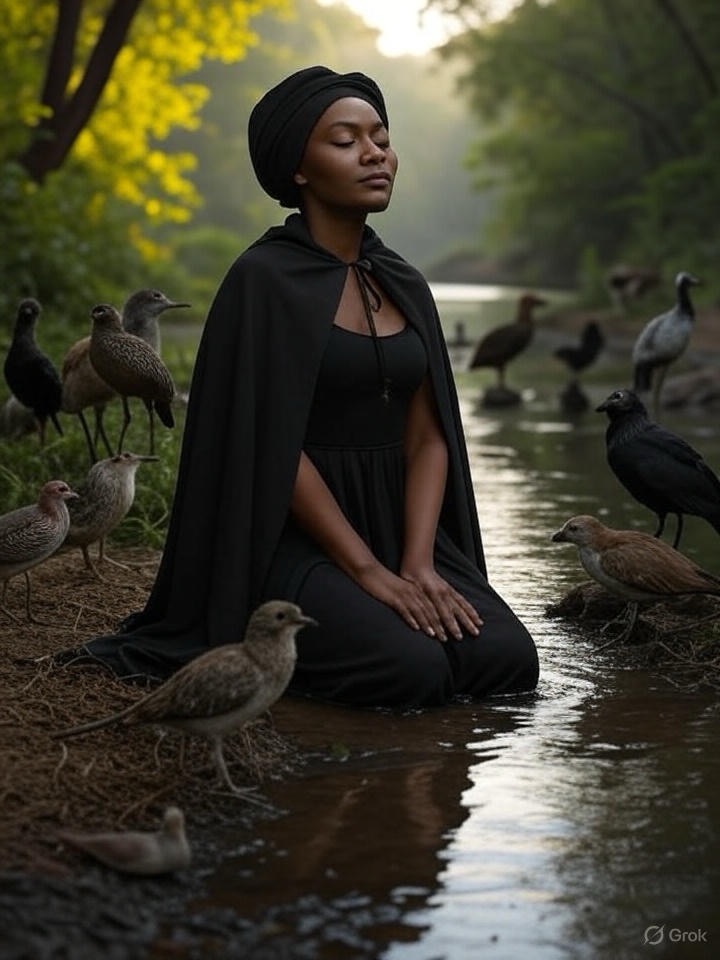
AI-Generated Image
As long as you are alive, redemption is possible. You can say no. You can choose light. You can live a clean life. You can acknowledge your Creator, and cultivate a daily spiritual practice to strengthen your discernment. With a strong spirit, you begin to recognize attacks—on your health, your relationships, your finances—and you learn how to resist them.
It’s not an easy journey. The war continues until we cross over to the other side. But this struggle has purpose. It is in our resistance that our souls evolve. It is through these tests that we are shaped into beings who can one day become the spirit guides for others.
So don’t give up. Don’t be discouraged. You matter in the fight between good and evil. The future of the world depends on souls like yours—souls who choose to walk in light, even when darkness whispers at the door.
Reflection Questions
Are there spiritual practices I can commit to daily to strengthen my discernment?
What do I need to release to live a cleaner, more spiritually aligned life?
Affirmation
I choose light. I walk with purpose. I am protected by the divine and guided by ancestors who dwell in love.
This is a question that bothers many Christians who aspire to learn about and practice their indigenous beliefs to connect to their African and family identity. Centuries of religious indoctrination and criminalization of indigenous spiritual practices under the Witchcraft Suppression Act led to many people being alienated from their identity, and struggling with their spirituality because they cannot always fully connect with Christianity. Others struggle with intense spiritual problems that manifest as mental or physical illness, financial difficulties, unemployment or lack of purpose which remain unresolved by conventional medicine and Christian prayers. As a result, they go to church on Sunday but consult indigenous healers to resolve their problems. Missionary churches do not accept indigenous healers unless they renounce their beliefs and practices to convert to Christianity because these are seen as the works of the devil.
Now that I know what I know about God & African Spirituality. My answer is ‘Yes’. You can be proud of your culture and traditional beliefs and be a devout Christian. This is an answer that I arrived at after years of wrestling with this issue in prayer, reading and research. As a Christian with a spiritual gift and calling that goes back many generations, it is essential that I resolve this for myself and hopefully assist others on their journey.
Spiritual Gift or Calling
Picture courtesy of Pinterest
Spiritually gifted people in African indigenous spirituality have specific signs. At birth, these include the baby being born with a caul, a membrane on the head or unbroken amniotic sac (ukuzalwa wembethe in IsiZulu) or with the umbilical cord wrapped around the baby’s neck (ukuzalwa unqambile in IsiZulu). In early childhood, signs include persistent illness with no medical explanation or abnormal physical or mental signs such as not speaking as a result of some kind of trauma. These normally require intervention from indigenous healers or prayers in charismatic churches.
People with a spiritual gift or calling have certain types of dreams and exhibit psychic abilities from an early age. There are many indigenous healers providing information on the Internet on dreams and signs with interpretations of varying accuracy. When they meet other spiritualists, they will tell them about their spiritual gift based on what they see. This is a universal fact across all cultures. There are people in every community who are chosen to heal people and carry messages from the Spirit for the benefit of the community.
One Universal Supreme Being
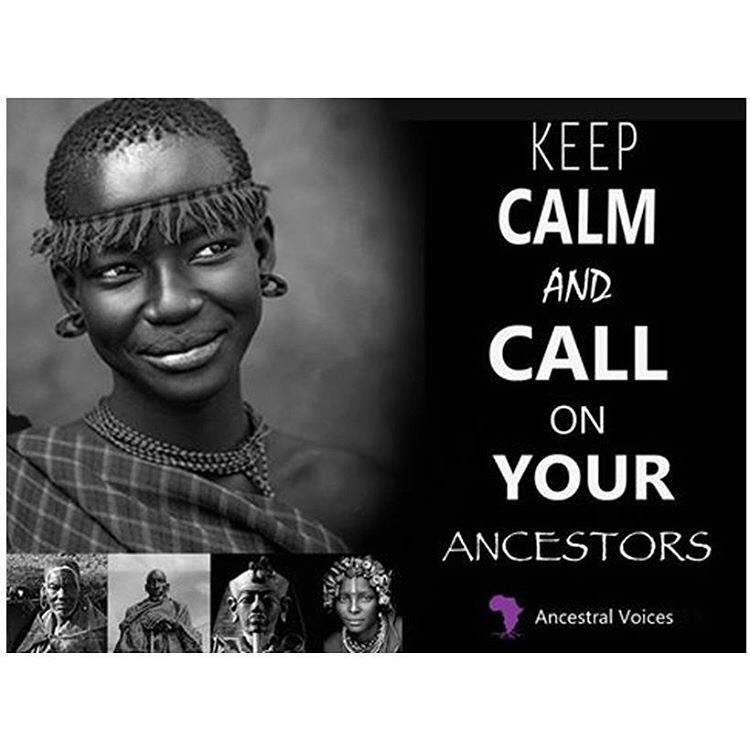
When you research different cultures and spiritual traditions, you will realise that the Creator is One. I am yet to come across a spiritual tradition that does not recognize a universal Supreme Being who created the universe and sets the laws for it to operate. Every religion and spiritual tradition uses prayer scripture, song, dance, ceremonies and sacred objects in various ways to communicate with the Creator directly or through an intermediary. God or the Creator is infinitely bigger, wiser and more powerful than we can imagine. He discerns the heart, knows our motives and when we we genuinely are worshipping Him regardless of the methods we use. He responds accordingly with billions of testimonies of answered prayers not only those of Christians.
People connect to God in various ways, song and dance is one, ceremony and ritual is another. There are many other ways to connect to the Spirit or divinity. African Independent Churches & Black American churches are ways of responding to the need to reconcile African culture with Christianity. Many Africans respond to the beat of the drum, dance & soulful spirituals during worship to feel the Spirit in order to connect to God. All spiritual traditions do this in one way or the other.
Picture courtesy of Pinterest
A core element of every spiritual tradition is the understanding of the universal principle of polarity, light & darkness, good & evil etc. This is expressed in the rituals & practices. Without that, it’s easy to be deluded into evil practices that cause destruction & mayhem. People who have found themselves on the dark side report fear, anxiety & depression as a result of dodgy spiritual practices because negative forces were invoked in their lives by their human guides. This has also caused people to label all other spiritual practices as evil.
Christianity and African Spirituality
Religion sets the rules of how people connect to Spirit. Religion is intended to guide people to connect to the divine. Institutional religion requires sticking to the rules and teaching acceptable doctrine. However when it is over-emphasized, religion inhibits spirituality. In the book of Matthew, Jesus criticizes the Jewish religious leaders repeatedly for their hypocrisy in keeping and teaching the letter of the law of Moses without justice, mercy or compassion and obedience to God, which are the spirit of the law.
There are many examples in the Christian Bible where God chooses to respond to someone who hasn’t followed the rules, such as the case of Hezekiah celebrating the Passover with people who were not ceremonially pure in 2 Chronicles. God speaks through Isaiah on how the people worship Him with their lips yet their hearts are far from him. He condemns the fact that they carry out the ceremonial activities but do not do so out of genuine obedience and keep on sinning against him on the side. God loves and will connect to a genuine worshipper no matter what they do or don’t do.
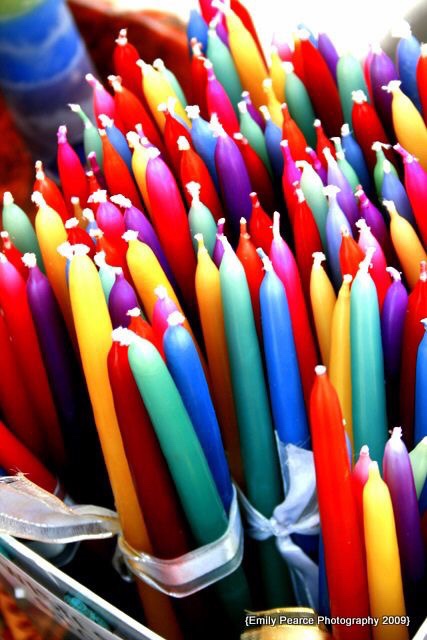
African tradition & Christianity can easily become religious. We are familiar with the way in which the Christian church is religious in terms of observances. Once you emphasize the physical and procedural aspects over the spiritual significance of the activity you become religious. For example, some indigenous healers insist that you must always light a certain colour candle and sprinkle snuff on the ground when communicating with ancestral spirits. Others say you shouldn’t light a candle at all because there were no candles in pre-colonial Africa. Either way, once you begin to prescribe how people conduct themselves to connect with the Spirit, you become religious.
To help resolve the conflict, you need to understand the origins of Christianity and the Bible and how Christian doctrine, i.e. what is taught in church evolved to what we know today. I will deal with this in another post. This will help in understanding how and why indigenous spirituality was demonized and discouraged. The Church has always been associated with power. The authorities needed, established and used institutional religion to ensure that law and order were maintained for the stability of the state. Christianity as a religion does not always assist in developing spirituality. In some denominations it has become ritualized and they do not teach the esoteric meaning and spiritual significance of what the rituals and ceremonies represent. In other denominations, they emphasize the feel good factor and have no ceremony or rituals. Both types emphasize blind unquestioning faith, however this leaves the spiritual seeker with more questions than answers.
The Calling Never Stops Calling
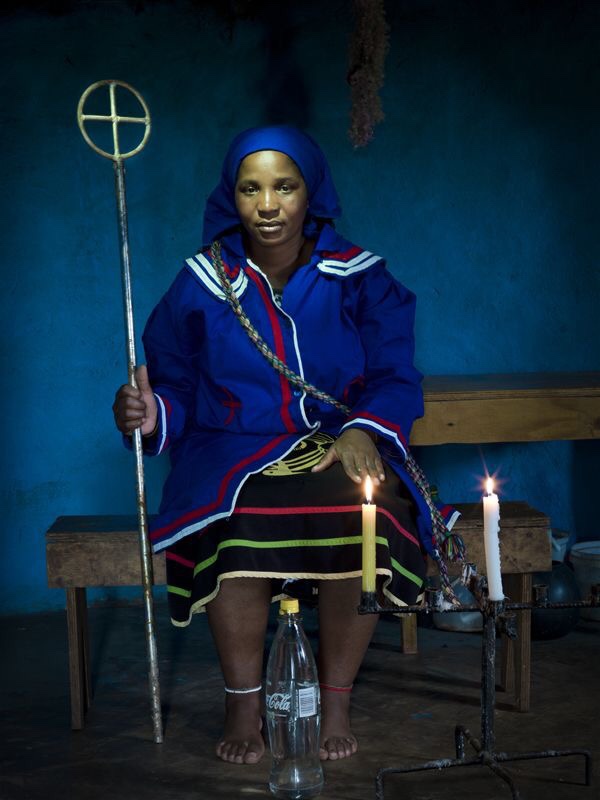
What has happened with Africans is that even when they convert to Christianity, the gift does not disappear nor does the calling. As a survival mechanism, many spiritually gifted people found a home in the African Independent Churches such as Ibandla lamaNazaretha known as the Shembe Church, which blends Christian and indigenous beliefs and practices. In these churches people found ways to exercise their gifts of healing using water, pebbles, salt and ash instead of herbs and animal products. Instead of divination using bones and shells, they use the Bible and verbal prophecy to provide information on the unseen. Instead of ancestral prints (amabhayi or amahiya) they adopted robes of different colours. This became known as isiprofeto or isithunywa and enabled them to evade arrest under the Witchcraft Suppression Act. Today young people are receiving this calling and there is a misconception that it is not an ancestral gift. It is an ancestral gift passed on by a blood relative who exercised their gift under the auspices of the church. If you feel or are told that you have a spiritual gift or a calling, it is important to investigate your family tree and identity which of your ancestors practiced as an indigenous healer or had a prophetic gift and operated in the church.
Picture courtesy of Pinterest
I listened to a podcast by Vusi Ngxande on thokozadlozi on Instagram talking to a traditional healer who went for initiation. She says the first ancestor to emerge was her great grandmother who was a member of the Methodist Church Women’s Fellowship, (umama woManyano or umama womthandazo). The reason is that the great grandmother had an ancestral calling that she did not fulfill. So she had a karmic debt which needed to be paid by someone in her bloodline. This is the reason why so many people are now receiving the ancestral calling as healers because the calling has not been answered for a number of generations because of the Witchcraft Suppression Act.
Picture courtesy of Pinterest
There are those that will argue that the belief that a spiritual gift is not scriptural. We should consider a number of examples. Jesus Christ was descended from Judah through King David and the prophecy by Israel his father was that the ruler’s staff would not depart from between his feet until its real owner comes and that was Jesus Christ. Christ therefore inherited the spiritual gift of leadership and ministry to God on behalf of the Jews and the Israelites from Judah through his mother Mary, who was descended from King David. This was the reason for the attempt on his life by Herod when he massacred all the baby boys in Bethlehem in 4 BC. Herod had been installed by the Romans, a descendant of Esau, Israel’s brother who had given up his birthright to lead the descendants of Abraham. He therefore was not the legitimate King of the Jews. By that time Israel had ceased to exist as a nation and the remnant had been absorbed into the Jewish kingdom. At his crucifixion Jesus was asked whether he was the King of the Jews. He did not deny it. A kingdom could only be obtained by inheritance or conquest in those days. Jesus has no army. Images of the crucifix today bear the inscription INRI which stands for Iessous Nazarenes Rex Judaeorum which is Jesus of Nazareth, King of the Jews in Latin.
It is important to realise that in Africa and the Middle and Far East, the king had to be initiated in the mysteries in order to be a person of spiritual power, able to communicate with God, the deities and spirits and to manifest miracles which included praying for rain and marshaling supernatural forces to defeat the enemy in war. You were not chosen as king simply because of your birth order. The nation’s healers’ and priests consulted various oracles and looked for omens and signs to choose the next king.
There is the interesting case of Elijah and Elisha in 2 Kings 2 where Elisha inherits a double portion of Elijah’s spirit after Elijah is taken up to heaven in a whirlwind. He puts on Elijah’s robe and takes his staff, divides the waters of the River Jordan and crosses it on dry ground. Those witnesses present testified that indeed the spirit of Elijah rested on Elisha. This presents an interesting parallel to healers who inherit ancestral gifts from people who are not blood relatives but are close to the person’s family.
Reconciling the Conflict
Picture courtesy of Pinterest
In my spiritual journey, having realised from my research that for Africans there is one Creator who made heaven and earth just like the Christian God, it set my mind at ease. This is because missionary Christianity misunderstood and misrepresented indigenous beliefs. They labeled ancestor veneration as worship and conflated it with the worship of demons. This was completely incorrect. Africans revere and respect their ancestors and call upon them for guidance and to intercede on their behalf with the Creator, in the same way as Catholics pray to the Saints to intercede on their behalf with God. Africans believe that their ancestors are intercessors because God is an unknowable mystery but uses them as messengers to guide and provide solutions for people.
Ancestral communication is not the same as worshipping idols. We generally do not have a physical image representing our ancestors because we understand them to be invisible in this dimension. An idol is a physical representation of a spirit, often one that is not of God. Demon or idol worship normally results in deviant behaviors, illness, mental instability and criminal behaviour, death and destruction. Guidance from the ancestors results in healing, prosperity and peace because they came from societies that adhered to a strict moral code. Africans do not call on spirits of ancestors that died a violent or untimely death or lived morally reprehensible lives. If a person was evil in life then they do not become good just because they are dead. If you invite those spirits into your life they will wreak havoc.
Picture courtesy of Pinterest
You can pray to God, ask for guidance and protection when doing spiritual work, speak to your ancestors and meditate to receive answers. They too were human, created by God & for many people were Christians too. God can send them just as he sends angels as messengers. If you understand what you are doing, then you need not fear acknowledging or hearing from your ancestors when they speak to you in dreams or intuition etc.
To ensure that you are equipped for a spiritual journey, be it an awakening or calling it is important is to study, interrogate and understand the essence and origins of religious practices and doctrine in order to discern what is useful in your own spiritual practice. To know whether the message is genuine, seek clarity from God and your ancestors and test the spirit using the scriptures you read and believe in your intuition. Spirituality cannot be studied, you have to practice it and find what resonates with you.
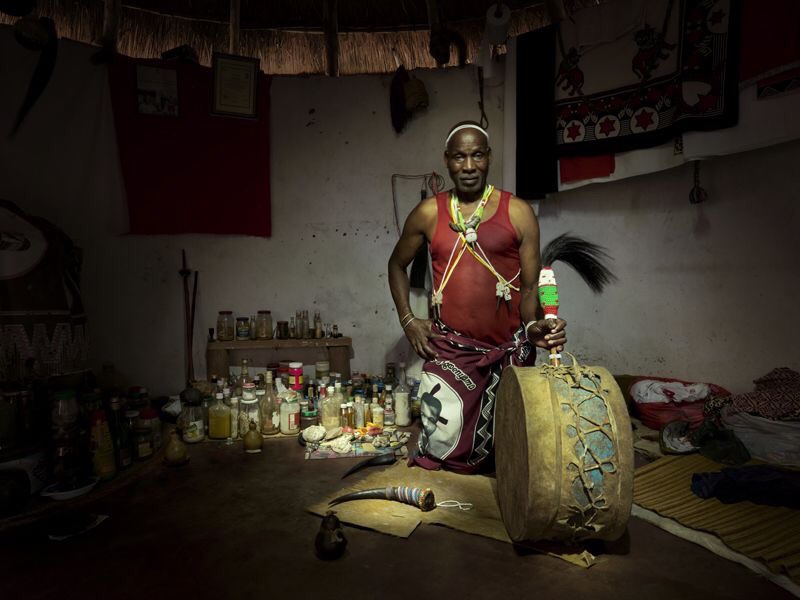
Isangoma African Indigenous Healer. Picture courtesy of Pinterest
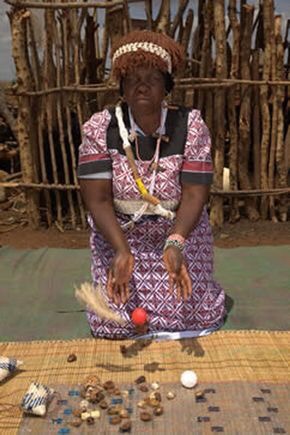
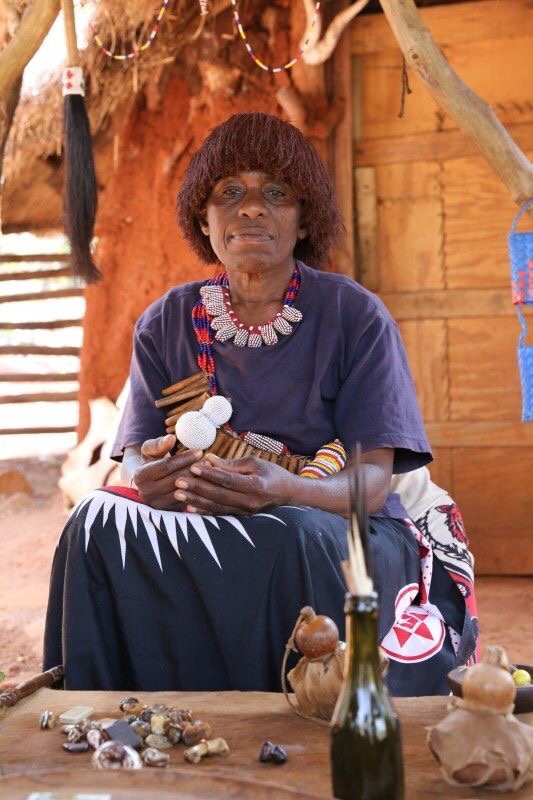
African Spirituality is broad and multi-faceted. Much has been made of the common manifestation of spirituality, that of the diviner or uMngoma or iSangoma. The word comes from the Bantu word ingoma meaning drum or song depending on the language and pronunciation. These healers undergo strict training to enable them to channel the ancestral spirits that are invoked through song that enable them to divine and heal. However there are many different types of healers with various specialities that channel spirits of ancestors from all over Africa. Statistics say 4 out of 5 people consult traditional healers across South Africa across racial lines.
Healers use various technologies to divine, diagnose, prophesy and heal. These includes herbs, roots, plants, seeds, water, sea salt, soil, ash, fire. Divination tools including bones, shells, crystals, carved wooden objects like runes or dominoes etc. Some use mirrors or a bowl of water for divination. Some operate in African independent churches as prophets and prayer warriors (abathandazi) and work mostly with the Bible, Christian songs, candles and water.
Regardless of the nature or origin of the ancestral spirit and how it is initiated, all indigenous healers have psychic gifts like clairvoyance (visions), claircognisance ( knowing), clairaudience (hearing) or clairsentience (feeling)or clairalience (smell) to get information from beyond the physical world in order to effectively carry out their calling to heal.
Spirit guide or Instructor or Gobela, indicated by the black print. Picture courtesy of Pinterest
To maintain their connection with the divine, healers pray and carry out certain rituals in order to heal and centre themselves. It is important for a healer to maintain a sound body, mind & spirit by any means necessary. Diet, exercise, meditation, prayer help with that. The training & initiation by all accounts is tough. It requires a trained spiritual teacher or mentor known as uGobela. All highly spiritual people are aware of the war between darkness & light & stand at the front line of that battle.
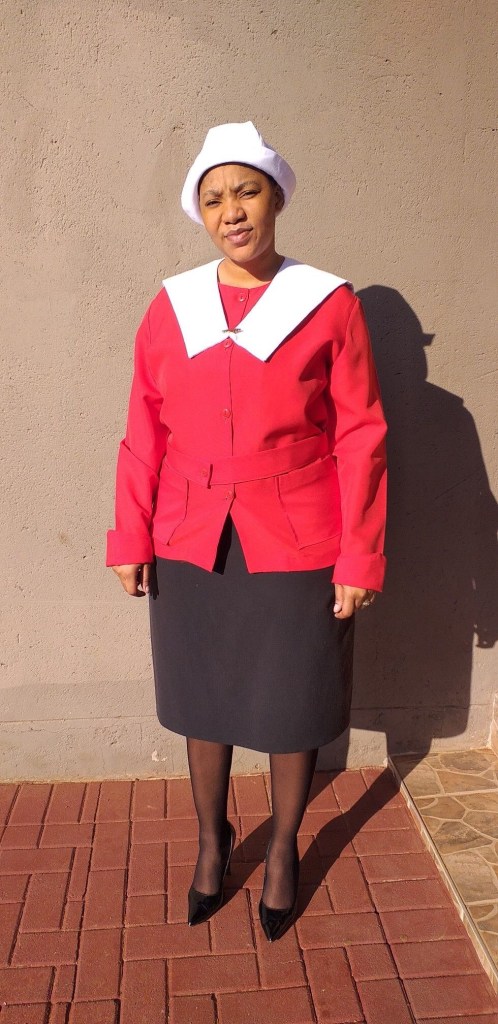
Traditional Healer who carries both Sangoma and Prophetic Gifts. Picture courtesy of Pinterest
There is a clear distinction between indigenous healers who are light workers and sorcerers that use dark magic. Healers are taught how sorcerers operate in order for them to be able to heal people, in the same way doctors and other medical personnel are trained in what kills people and how, in order to heal them. However all healers must make a choice to work with the light or with darkness. Those that work with the light must be spiritually pure. Unfortunately due to the Witchcraft Suppression Act and religious indoctrination all spiritualists and spiritual practices have been incorrectly labeled as evil.
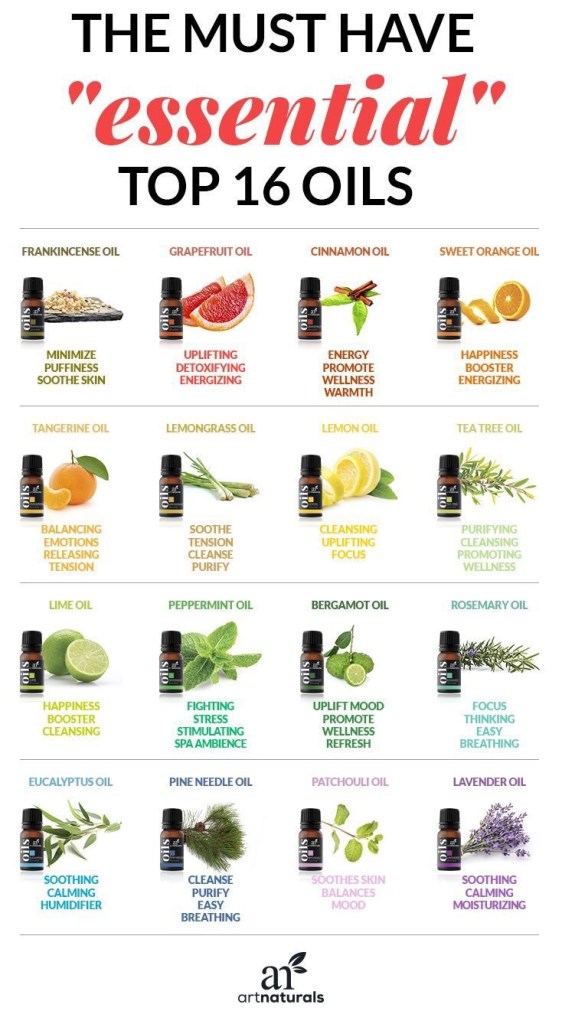
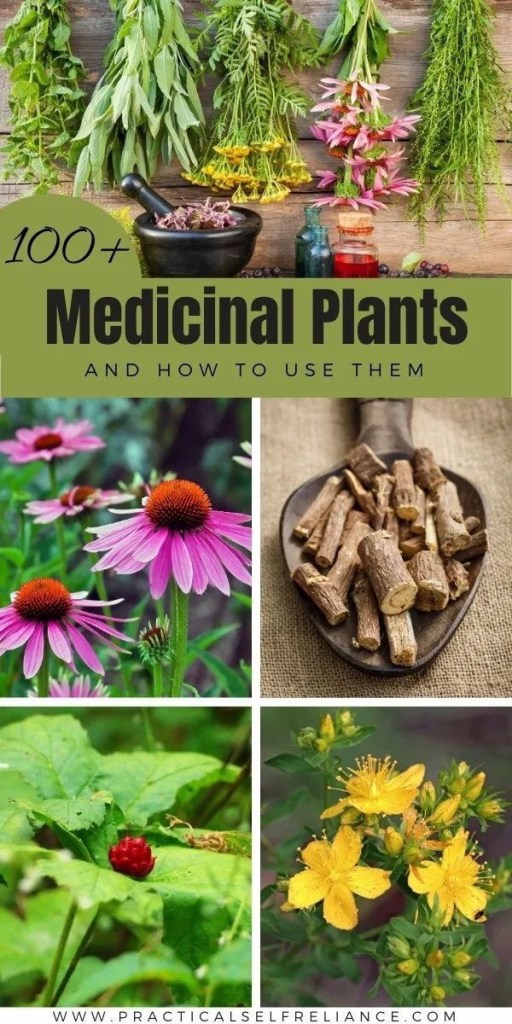
In my research on spirituality, I’m fascinated by the way South African indigenous healers are incorporating different healing modalities such as meditation, yoga, crystals, astrology, numerology, aromatherapy and colour healing. It dawned on me that this is a natural evolution. Spirit is infinitely wise and powerful and will use any sacred object to accomplish what it needs to. However, all these practices associated with European and Asian spiritual traditions originated in the ancient African kingdom of Kemet in modern-day Egypt which birthed most of the spiritual traditions across the world so in a way it is a return to our indigenous knowledge systems in a modern form.
Crystals. Picture courtesy of PinterestAromatherapy Oils. Picture courtesy of PinterestMedicinal Plants. Picture courtesy of Pinterest Oracle Cards. Picture courtesy of Pinterest
Indigenous African Spirituality is more than just ubungoma or shamanism, beads, snuff & traditional beer. If you live in an urban area, you can’t go to the bush to collect herbs etc. for healing. So it makes sense to use other modalities to balance & heal mind, body & spirit. There is such beauty & diversity in African Spirituality yet what I see is common among genuine indigenous healers is a desire to heal which overshadows any fear or adversity they endure. If what they do is so evil, surely they wouldn’t also be vulnerable to spiritual attacks?
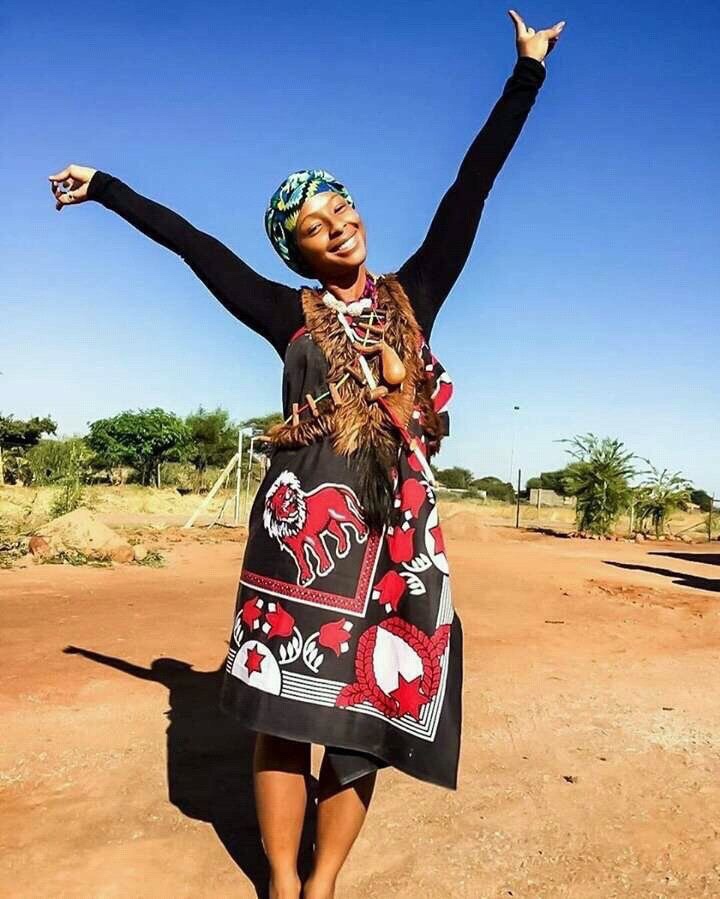
Boity Thulo, South African Celebrity who recently underwent initiation. Picture Courtesy of Pinterest
If you are undergoing a spiritual awakening or have an interest in African Spirituality, there are many healers that offer information and guidance on various social media channels FaceBook, Instagram and YouTube for people needing to consult and aspiring healers. Notable examples include AfroSavvy, Gogo Dineo Ndlanzi and Sangoma Society and Bana Ba Moya on YouTube, Vusi Ngxande’ podcasts on ThokozaDlozi on Instagram. They are also available on Twitter. Research is very important to ensure that you make the most of the healers’ support and avoid unnecessary confusion, drama and trauma on your journey.
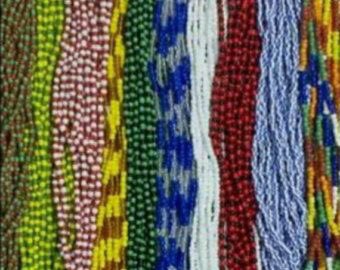
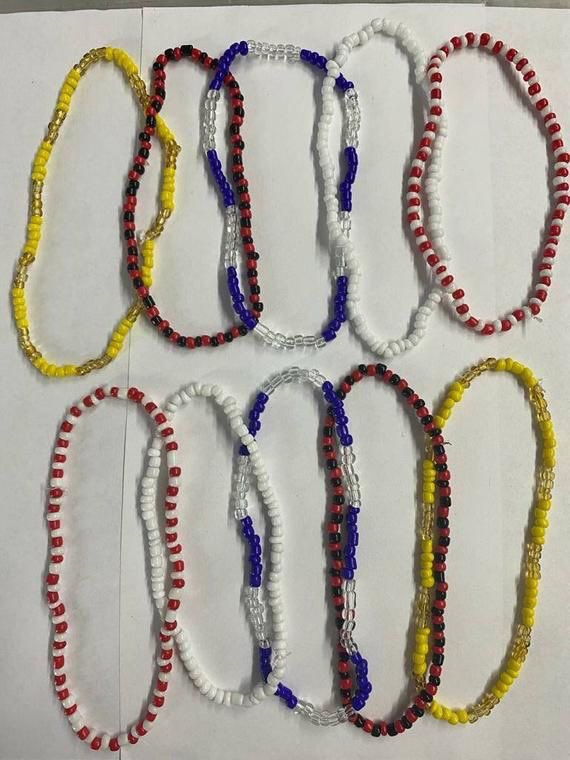
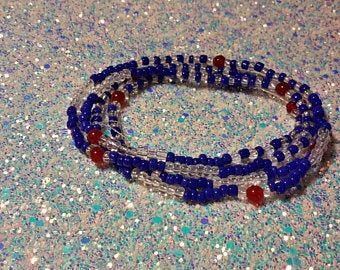
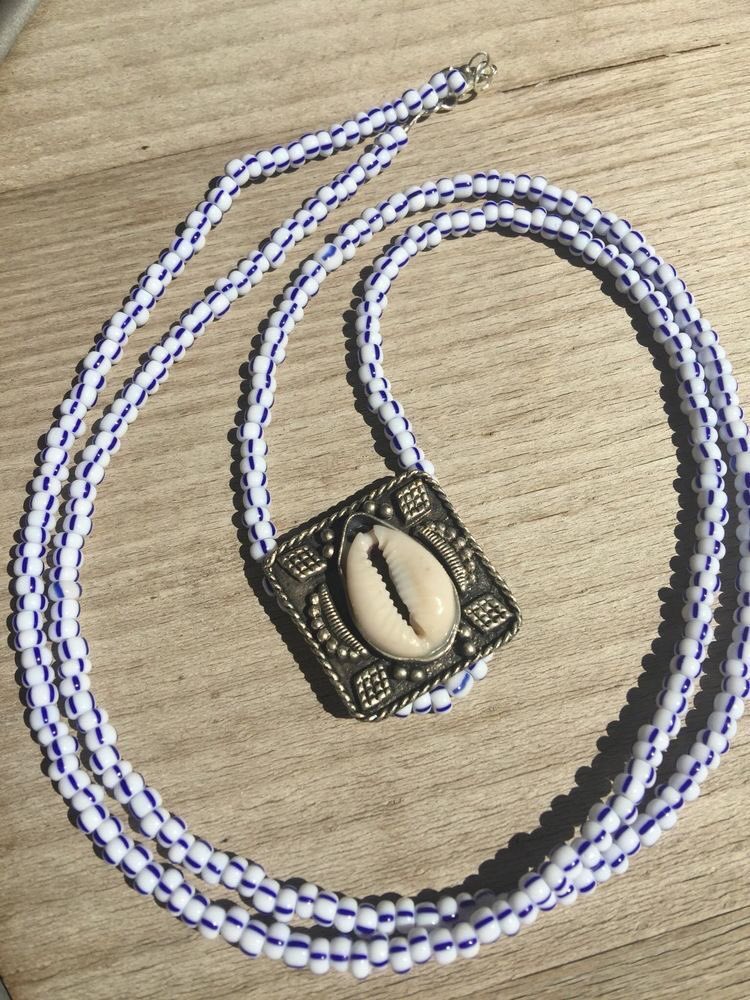
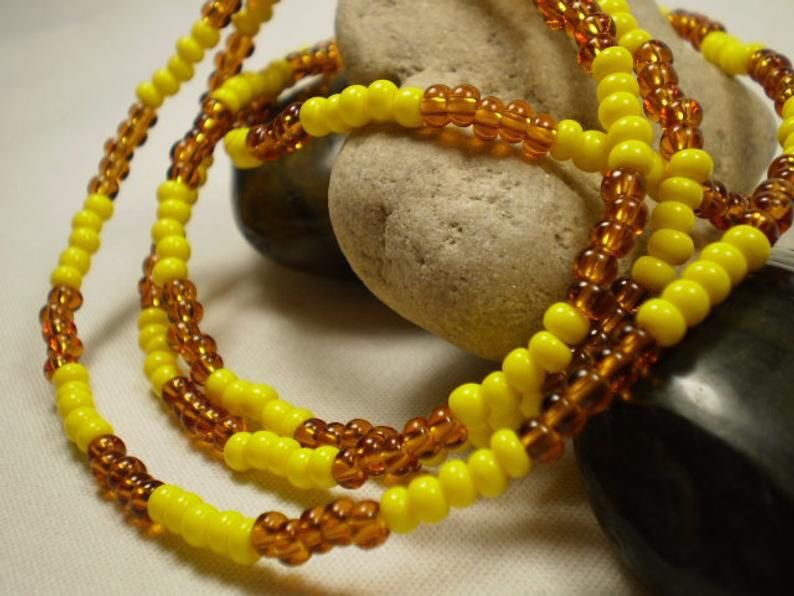
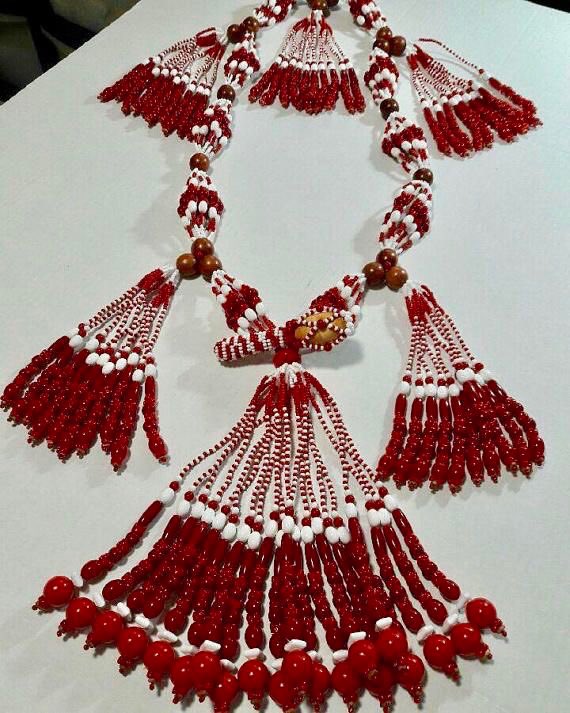
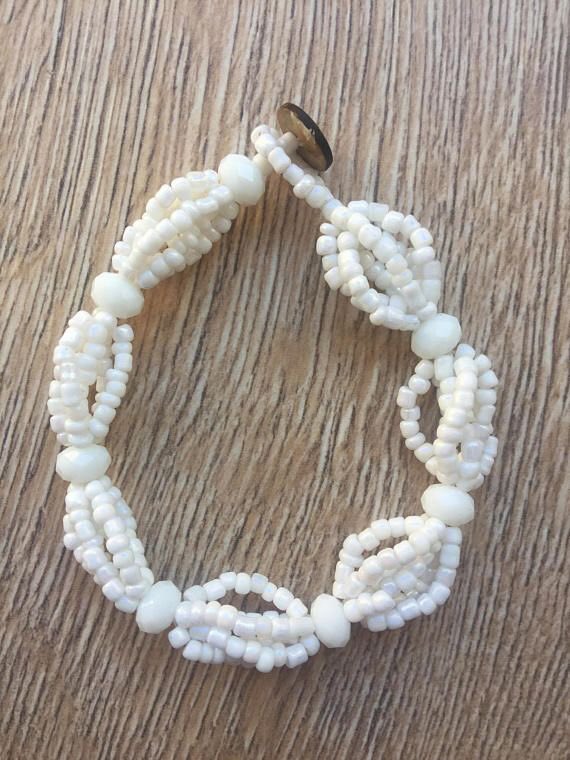
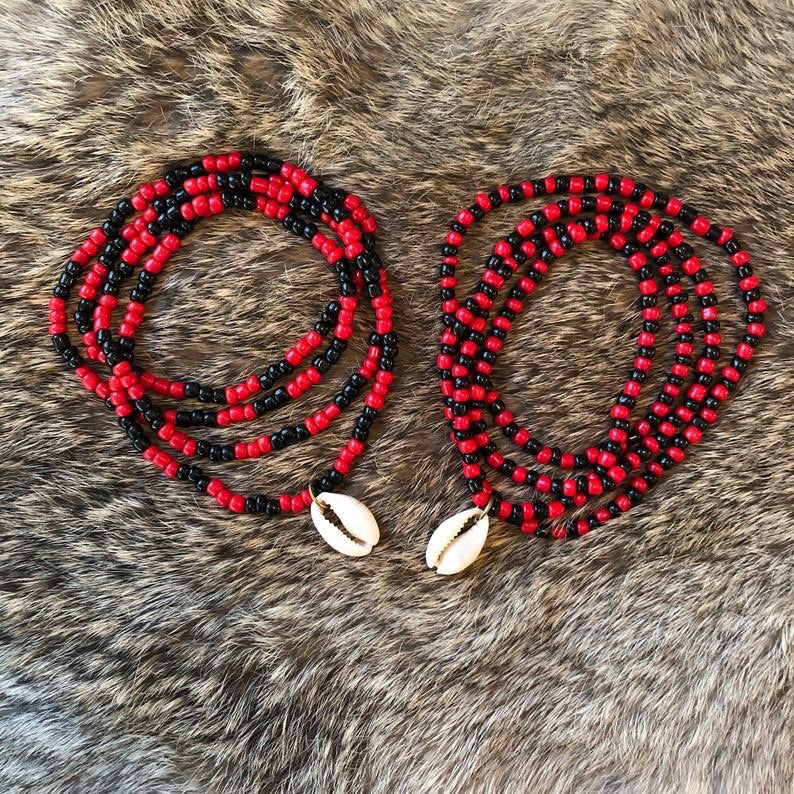
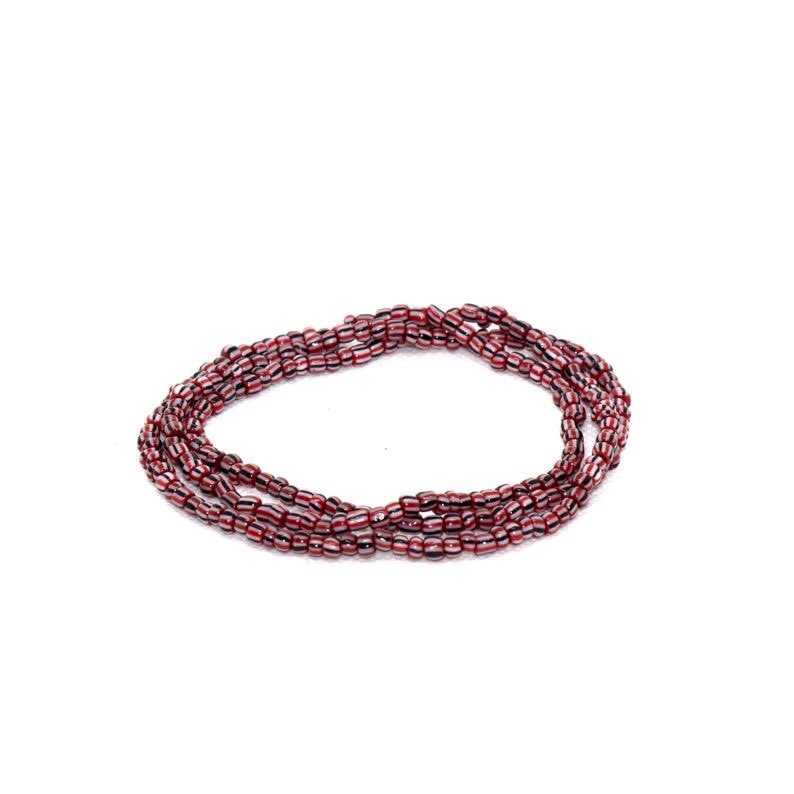
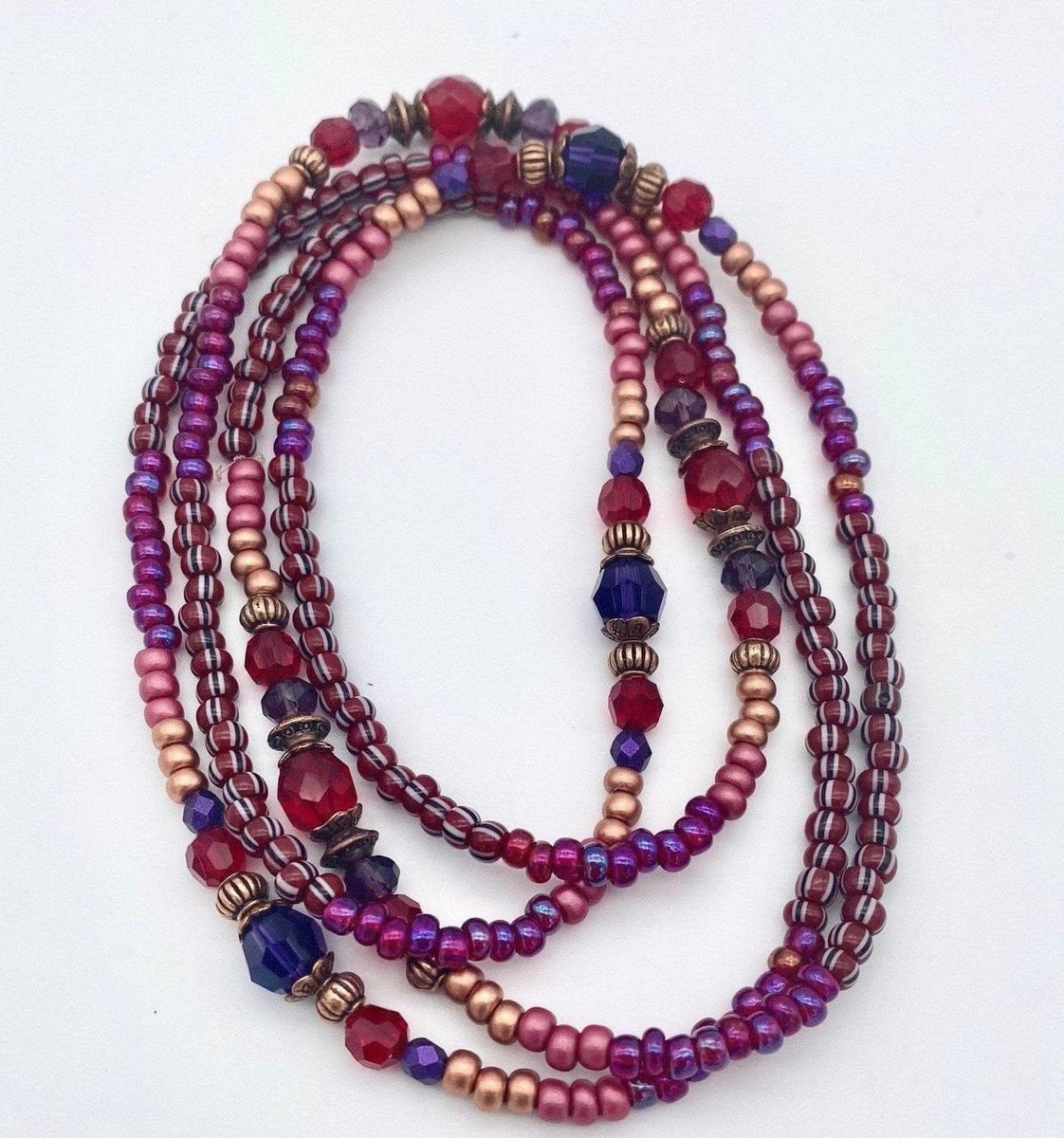
There are some interesting similarities between spiritual practices in Southern Africa & Ifa – Yoruba spiritual tradition. Take the wearing of beads for instance. Beads called ubuhlalu in Nguni languages or dipita in SeSotho or SeTswana are worn by people with a spiritual gift or calling in Southern Africa on instruction by the ancestors often in dreams. In the Ifa tradition the beads or eleke are gifted to initiates by the Ifa priests and priestesses according to the Orishas whose energies are dominant in that person. Common colours are white, blue and white, blue, clear and red beads, red and white, black and white bead, yellow & Amber beads. The designs can be a simple single strand worn on the wrist or around the neck or multiple strands with elaborate designs sometimes including seashells, bones or crystals.
A possible reason for the similarities is the spreading of African Spirituality with the migration of Bantu people in different waves from north, east, central and west Africa to the south. Some of the songs sung by South African healers learnt from being passed on by other healers in a trance state have lyrics that are not in a recognized South Africa language and sound like West and Central African languages that sound like BaMbara, BaMileke known to be older Bantu languages and Luyana and Tshiluba spoken in the Congo.
Picture courtesy of Pinterest
The colours correspond to a cosmic energy which is personified as a god or Orisha. Similar correspondences are found in Kemetic Spirituality. The colours also correspond to the elements – earth, water, air, fire. There are many Orishas but there are the most popular ones.
Picture courtesy of Pinterest
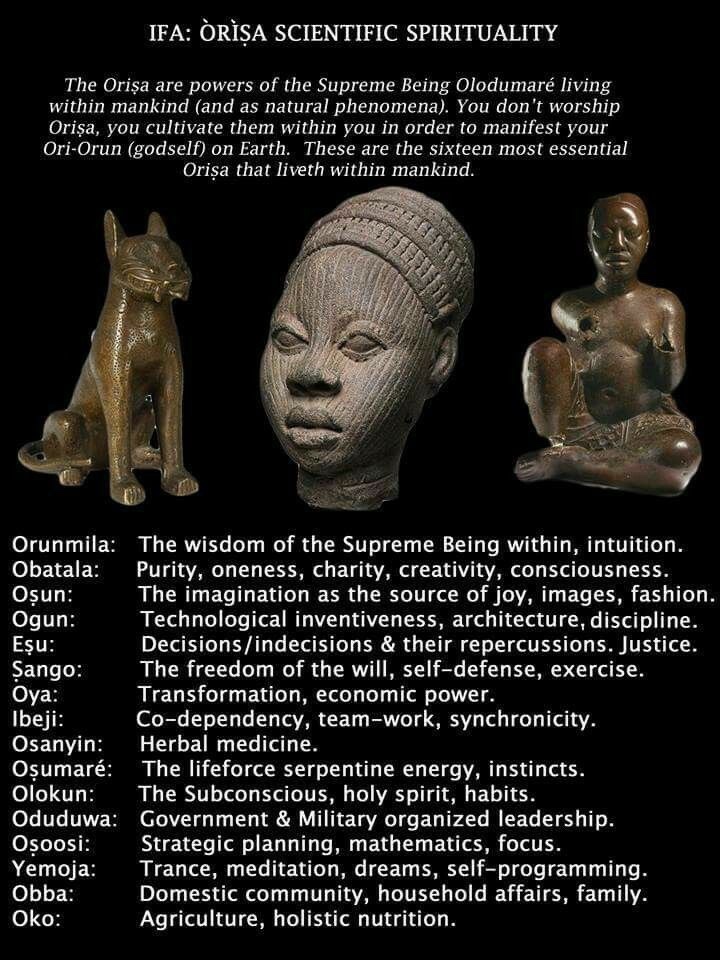
Yoruba tradition recognizes the Source Or Creator, called Olorun or Olodunmare. The Orishas are manifestations of Olorun as cosmic energies present in the universe and in all human beings. An Orisha is a spirit that reflects one of the manifestations of God. There are four hundred and one of them in total, each playing a role within the Yoruba pantheon. Twelve of them however can be equated to the twelve signs of the Zodiac along with their respective houses.
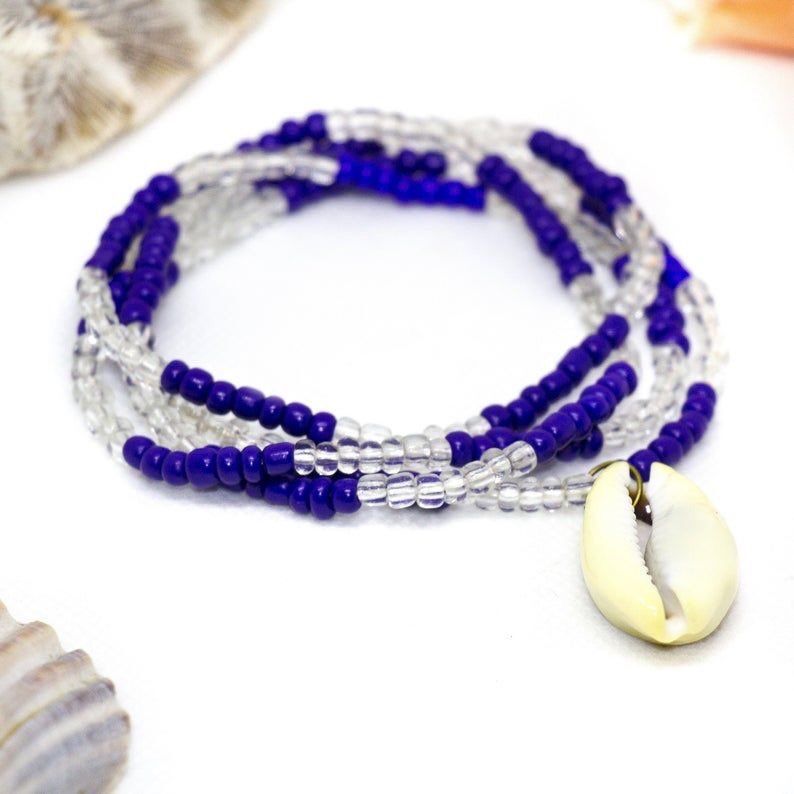
Olokun was the first of the Orishas. He dwells in the depths of the ocean & is associated with wisdom, divination & revered for giving prosperity. He is associated with the astrological sign of Pisces. This sign deals with the unconscious and things beyond the physical plane. Olokun’s aspects are therefore expressed within the astral, the subconscious, and altered states of consciousness that is experienced during meditation, initiation, and spirit possession. The colours of Olokun’s eleke are blue, white and clear beads. His element is water, particularly sea water. His qualities are similar to those of the the Ndau spirits of Southern Africa who are associated with rivers and the ocean. People possessed by Ndau Spirits, particularly those of Ndau ancestry from Zimbabwe, Mozambique and north-eastern South Africa are highly spiritual, skilled healers and some are feared or sought after for their prowess in dark magic.
Picture courtesy of PinterestPicture courtesy of PinterestPicture courtesy of Pinterest
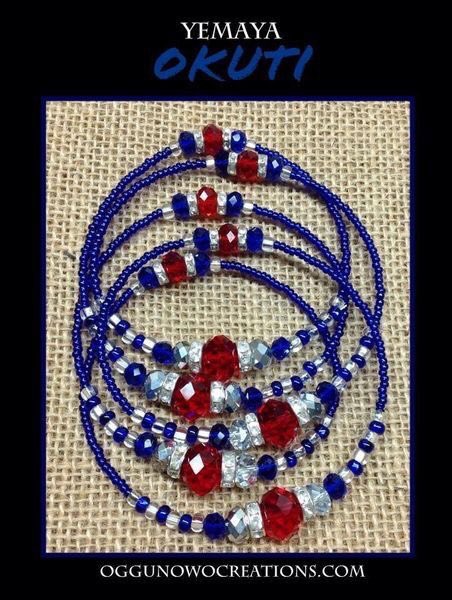
Some believe Olokun to be a male whose wife is Yemaya or Yemoja, the Mother of all Orishas & Goddess of the Ocean. She governs water, motherhood, and protects pregnant women. The colours of her eleke are blue & white & some designs include red similar to Olokun and seashells. She is associated with the sign of Cancer, the crab, a sea creature with a protective shell that does not let go once its claws grab something, also known for being maternal, protective, nurturing, and instinctive and the 4th house associated with the home. Her name is a contraction of the Yoruba words “Yeye omo eja” which means “Mother whose children are like fish”. This represents the vastness of her motherhood. The ebb and flow of the ocean tides are a result of the moon, the fourth house’s ruling “planet”. Her element is water, particularly sea water as all rivers flow to the ocean. Yemaya’s qualities are also similar to Ndau spirits that are associated with the oceans. Female healers are strongly affected by Ndau spirits because they dwell in the sacral chakra, close to the belly and reproductive organs.
Picture courtesy of Pinterest
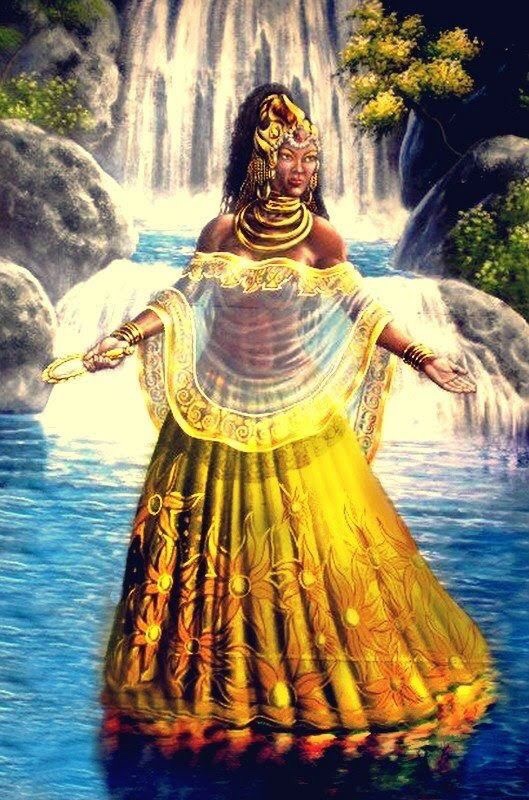
A popular Orisha is Oshun, goddess of divinity, fertility, femininity, beauty & love. She is the daughter of Yemaya & consort of Shango. Taurus is the ruling sign of the second house, which is the house of possessions. This should not only be understood as material possessions but also as traits and characteristics that we value about ourselves. The ruling planet Venus is also the Roman goddess of love, whose Orisha equivalent is Oshun. Oshun is the goddess of fresh water (opposite to the salty, ocean waters of Yemoja), sensuality, prosperity, love, and fertility. The colours of her eleke are yellow and gold. She is associated with fresh water like the Ndau spirits that also reside in the sacral chakra and govern creativity, sexuality and prosperity. Ndau people, women especially are reputed to be very resourceful and enjoy the finer things in life, particularly clothes, jewelry, shoes and perfume. Oshun is often depicted as a beautiful young woman with a mirror. Beyoncé is believed to be a follower of Oshun.
Picture courtesy of Pinterest
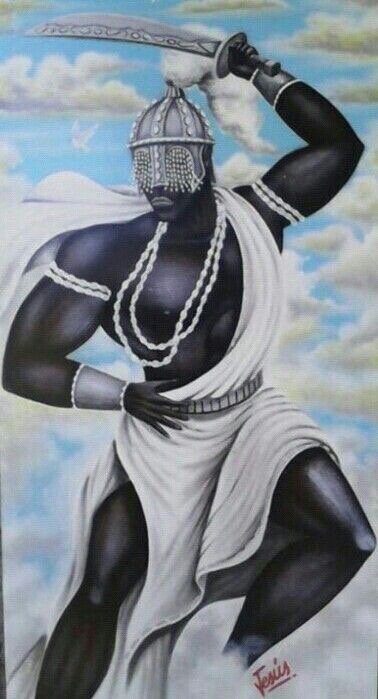
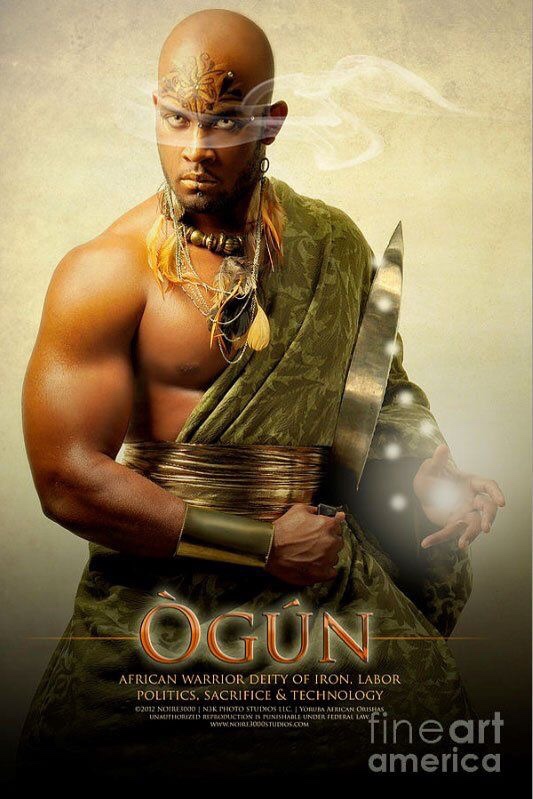
Shango the god of iron and fire is the most feared and powerful of the Orishas and believed to create thunder and lightning. He is the consort of Oshun. He rules the astrological sign of Aquarius which is associated with rapid social change, upheaval, and rebellion. These traits all reflect Shango, the warrior Orisha of thunder, lightning, and fire. Once a living king on Earth, Shango is known for working miracles after his death. This elevated him to the status of Orisha. The colours of his eleke are red and white. His qualities are similar to the Nguni Spirits which are associated with war and are powerful, protective energies. Beads worn by diviners with Nguni Spirits are red and white.
Picture courtesy of Pinterest
Obatala was the Orisha tasked with creating land and human beings. He is believed to be the father of Shango, a warrior, a powerful & magical being, capable of manipulating cosmic energy & capable of reading minds. The colour of his eleke is white. His element is air. The Orisha of purity, Obatala was sent by the Supreme Being at the beginning of time to form the Earth. He also constructed the bodies of humans. Obatala completed his construction of the bodies he created by adding heads to them. He therefore became known as the owner of heads. The head is symbolic of intelligence, higher education, and deeper understanding, all which the ninth house represents. Obatala is associated with the sign of Sagittarius and the ninth house, which is is the house of philosophy and is ruled by the planet Jupiter, His qualities are similar to those of the AbaLozi spirits that communicate in whistles and bestow gifts of clairaudience and claircognisance among other psychic gifts to those they possess. AbaLozi spirits often give gifts related to prophecy and pre-cognizant dreams. They like to work with white candles and beads.
Picture courtesy of Pinterest
Elegua or Eshu is the messenger & Orisha of the crossroads. He is the ruler of the sixth house, and the sign Virgo. Health, work, and service are central to the sixth house. It is ruled by the planet Mercury, the messenger of the gods within the Roman pantheon. Eshu is the Orisha that stands at the crossroads between the physical world and the spirit world. His duty is to be the intermediary between man and the Orisha. Therefore, when one wishes to call upon the Orisha, he or she first gets permission from Eshu. This is symbolic of clearing and preparing the mind to receive whatever message the Orisha have for you. He is invoked to venerate the ancestors & open the path to Olodumare the supreme deity. The colours of his eleke are red, black and white. His elements are earth and air. African ancestral spirits are believed to carry messages from the Creator. Red beads symbolize the sacrifice that connects the healer to the ancestral spirits, while black beads symbolize death, a metaphor of dying to your old life and accepting your calling as a healer or diviner. Abalozi people in Zambia also dress in red and black for ceremonies. Healers with unMndiki spirits from our oldest blood ancestors among the Mandinka people of Mali and Burkina Faso also wear red and black or red and white beads.
Picture courtesy of Pinterest
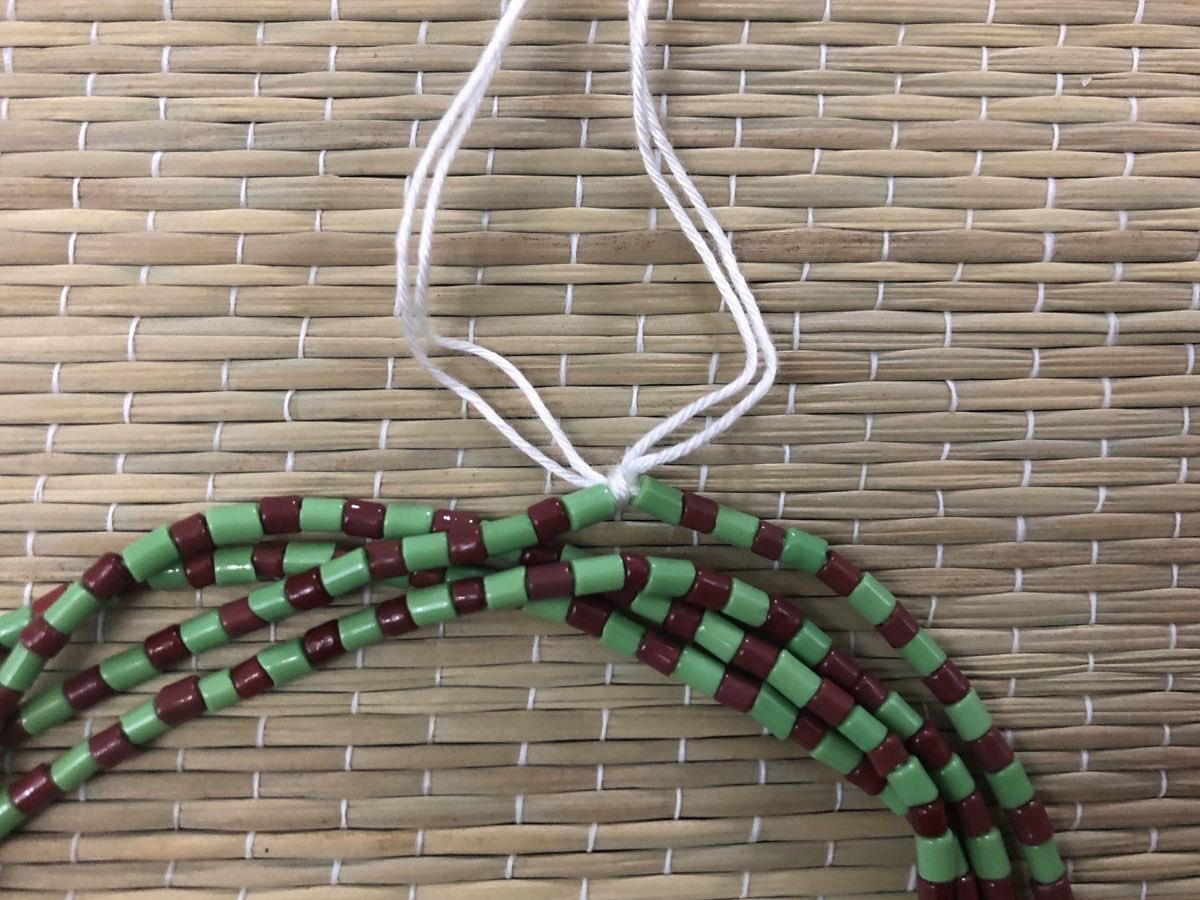
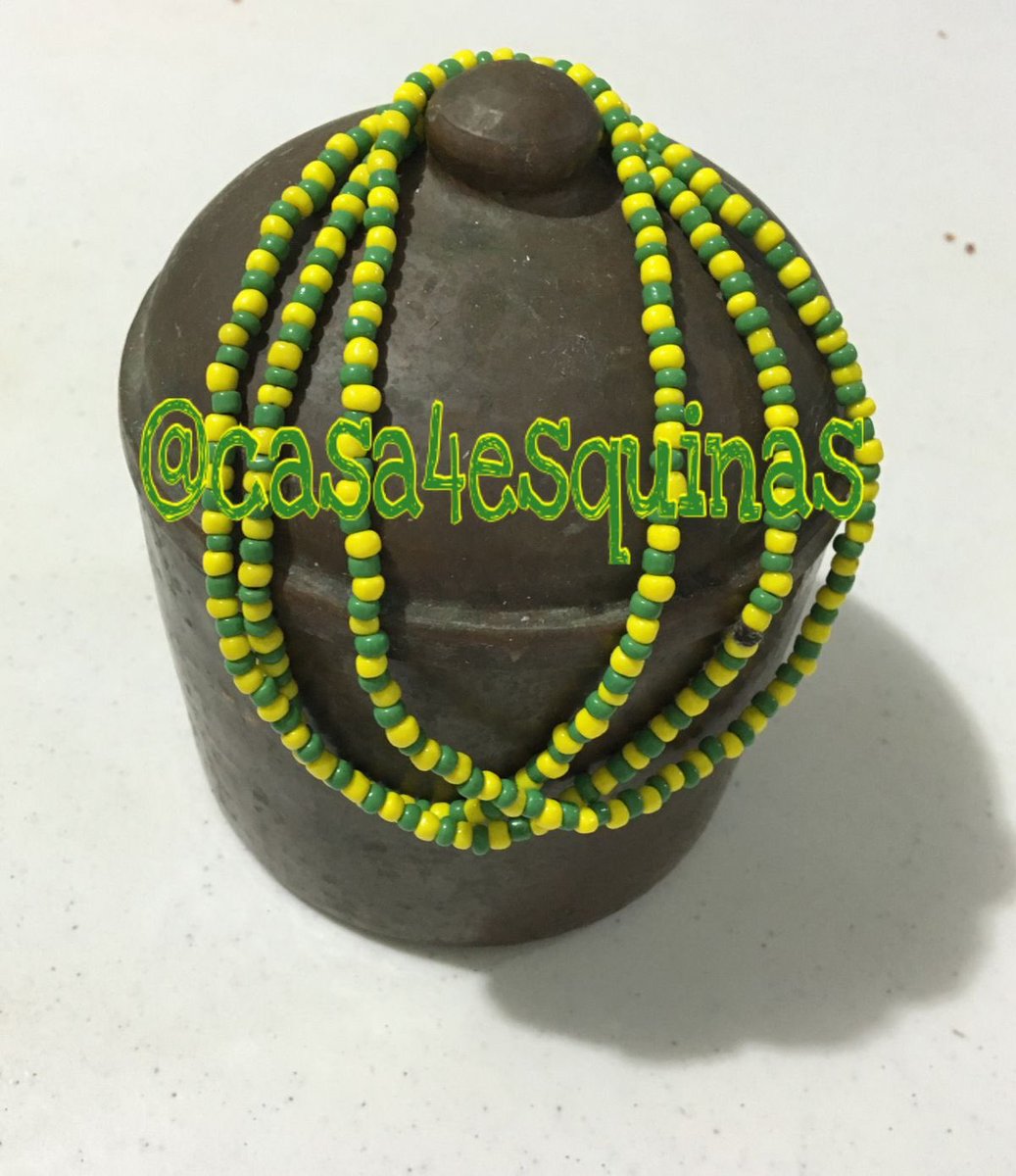
Orunmila is the Orisha of knowledge, destiny & prophecy. He assisted Olodumare in creating the universe, planted the first plant on earth & designed the 16 characters of humanity & a healer of other Orishas. He is associated with the sign of Leo, the fifth house of the Zodiac, of is the house of creativity and pleasure, ruled by the sun. This house deals with gaining pleasure through acts of creation, artistically and even procreation i.e. the creation of offspring. The Sun, the ruling “planet” of the fifth house, is a symbol of creative energy, illumination, and knowledge. These are all aspects the Orisha of wisdom, knowledge, and divination Orunmila reflects. It is Orunmila’s duty to record the destiny of individuals the moment the breath of life is given to them. The colours of his eleke are green, green and yellow or green and brown. His elements are earth and water.
Some African healers wear green, green and yellow or green and brown beads and carry the gift of divination using whatever tools their ancestors use, be it bones, tarot cards, shells, crystals, water etc. They may also carry the gifts of alchemy the ability to transmute negative energy into positive energy and herbalism, the ability to heal using herbs and other natural elements. They are known as inyanga, those who use the phases of the moon to gather herbs or igedla: keepers of knowledge and able to heal the body and spirit using knowledge of plants and other natural elements.
Picture courtesy of PinterestPicture courtesy of PinterestPicture courtesy of Pinterest
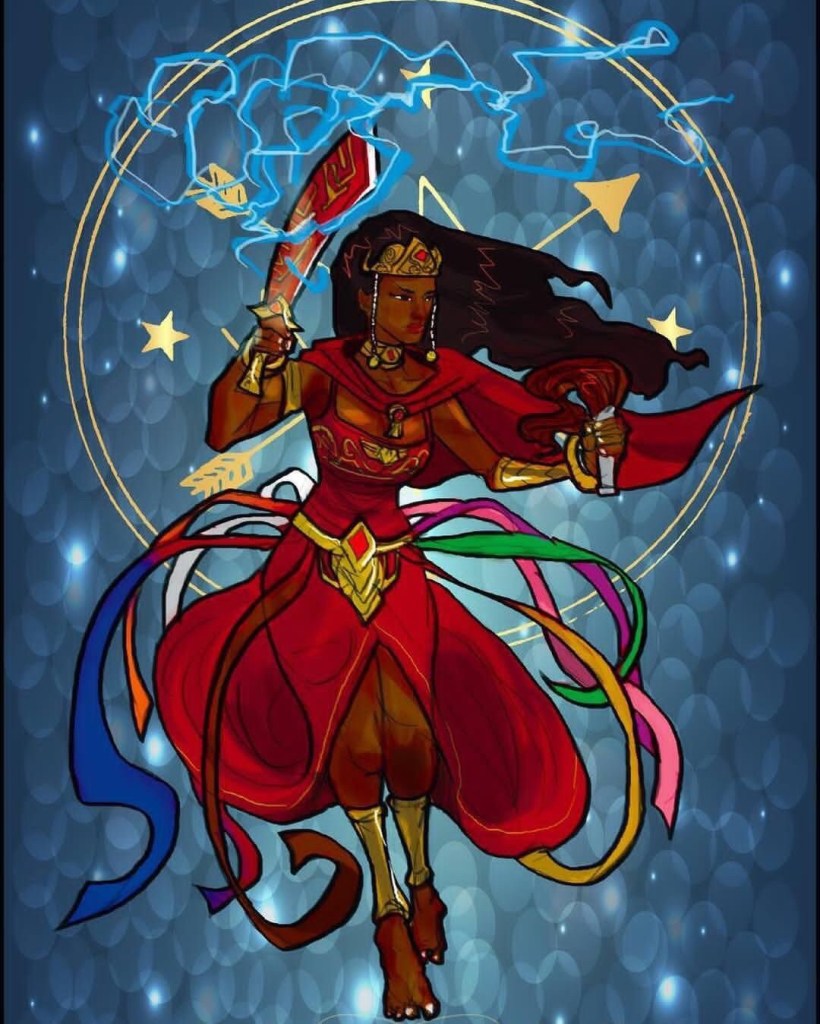
Oya is the goddess of the weather, psychic abilities, rebirth intuition & clairvoyance. She also carried the souls of the dead to the next world. She is loving & fierce. Her symbol is a flywhisk or ishoba carried by sangomas. The colours of her eleke are the rainbow, purple & red. Her elements are air, water and fire. Oya, is associated with the sign of Scorpio and the the eighth house, ruled by Mars. This is the house of transformation, regeneration, death, sex, and rebirth. She is the powerful force in nature that can change the face of the Earth. She embodies the tornadoes and twisters that uproot trees and houses with her destructive winds. This powerful Orisha is also responsible for carrying the spirits of the newly departed to the spirit world.
In the Zulu Cosmology, the goddess Nomkhubulwane is one of the seven messengers of the Creator and rules over weather and rain and her symbol is the rainbow.
Picture courtesy of Pinterest
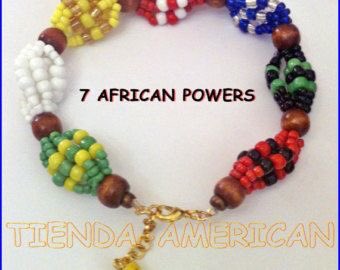
Some priests have associations with multiple Orishas so their eleke or beads with have sections or combinations for the cosmic energies they channel or work with. They have initiates & the eleke are specially strung & given to them. 7 African powers is an example.
Picture courtesy of PinterestPicture courtesy of Pinterest
If you are drawn to unusual bead colours & combinations or see them in your dreams these may be clues to your ancestry or heritage & spiritual path. Beads used intentionally can strengthen spiritual connection & heal you through the vibration of colour. You don’t have to be an initiated healer to wear beads in Southern Africa. These usually indicate the nature of your calling, your dominant energies and the parts of your energy field or chakras that you need to balance and heal to effectively connect to Spirit and to protect you.
Zulu traditional dress. Picture courtesy of Pinterest
The Zulu people are the largest ethnic group in South Africa, found mainly in the south-east in KwaZulu Natal. KwaZulu means the place of the Zulus. In Zulu cosmology the Creator (UMdali/uMenzi) has 7 aspects or messengers known by some as gods because they had greater power and consciousness than human beings. The number 7 is a sacred symbol of divine fullness. Each Of these divine messengers had a divinely ordained function.
The Orishas are the deities in the Yoruba spiritual tradition known as Ifa. The Yoruba people are from the south and west of Nigeria. The Orishas are aspects of the Supreme Being or the Creator given charge over different aspects of life. There are many Orishas however there are seven that are most popular and known as the Seven African Powers.
There are interesting parallels between the spiritual beliefs of Zulu and Yoruba people. Primarily these are centred around a single Supreme Being, the Creator. The Creator expresses his character through different cosmic energies that are personified as deities or gods. Human beings are made in the image of the Creator in terms of spirit so they carry the same energies within them. For the ease of human understanding human social constructs such as the family are used to teach complex cosmic concepts and stories are used to convey the wisdom in a way that can be readily understood, memorized and passed on from generation to generation.
Ifa Orishas. Picture courtesy of Pinterest
UMvelinqangi is the chief of the messengers. He connects people to all the other messengers. He is responsible for balance and centrality. He is the one known as Modimo wa Badimo, in SeTswana, the greatest of all the spirits. He has similarities to Obatala in the Yoruba spiritual tradition.
Ifa Orisha Obatala. Picture courtesy of Pinterest
Ma, is the Universal Mother, Credo Mutwa, the famous Zulu Shaman called her Ninavanhu Ma. She gave birth to the first humans. She is a caregiver and nurturer. She gave the original blueprint of motherhood and embodies that powerful cosmic energy. There are similarities to Yemaya in the Yoruba tradition.
Ifa Orisha Yemaya. Picture courtesy of Pinterest
Sodumo is responsible for the destinies of human beings. He connects the living and the dead. From him, each soul is given it’s assignment on earth to grow in consciousness through various experiences chosen by the individual before they are conceived. There are similarities to Orunmila.
Picture courtesy of Pinterest
Nomkhubulwane governs the phenomenon of rain and rainbows. Ancient priestesses prayed to her for rain. The original shapeshifter, she adopts the form of any animal. She sounds similar to Oya, the Orisha of weather & storms whose symbol is the rainbow.
Ifa Orisha Oya. Picture courtesy of Pinterest
Somandla embodies the cosmic energy of vitality and power and gives humans the power to achieve anything. African Christians pray to USomandla for strength and capability as he represents the Omnipotence of God the Creator. His colour is red. He shares similarities with Ogun.
Picture courtesy of Pinterest
Nomhoyi embodies the energies of sensuality & fertility. She is associated with rivers. She brings spiritual cleansing & consciousness which comes with baptism. She brings peace and protection. She shares similarities with Oshun, the Orisha of fertility beauty and love.
Ifa Orisha Oshun. Picture courtesy of Pinterest
Mlenzemunye, (means the one-legged one ) embodies the cosmic energies of courage, protection, & change. He protects people from harm. His Ifa counterpart is Osanyin, also🦵 who is in charge of healing & magic associated with diviners & herbalists.
Ifa Orisha Osanyin. Picture courtesy of Pinterest
The number 7 has significance in numerology, sacred geometry and many other spiritual traditions including Christianity. Isaiah chapter 11 tells of the 7 spirits of the Lord. Revelation tells of the 7 eyes of God which symbolizes the 7 spirits of the Lord. This is why the Jewish menorah or lamp stand has 7 lights or candles.
Christianity found resonance with African people because the Christian God was in many respects similar to the Creator revered by Africans for millennia. Human beings may be divided by religion, language, culture and tradition but are united in the Spirit.













 PrincessPearlManzini
You must be logged in to post a comment.