In a world that often feels fractured—morally, spiritually, and socially—many of us are yearning for a path that brings us back into alignment. Not just with ourselves, but with nature, with truth, and with one another. Long before modern laws and religious doctrines, the Ancient Kemetic (Egyptian) civilization laid down a sacred spiritual framework for living a just and harmonious life. At the heart of this framework was Ma’at—the divine principle of truth, justice, balance, reciprocity, and cosmic order.
Central to this path are The 42 Negative Confessions of Ma’at—a profound ethical code that predates the Ten Commandments by thousands of years. They are not rules meant to control, but rather sacred reflections to guide our inner compass toward living in alignment with divine law.
🌾 Who Was Ma’at?
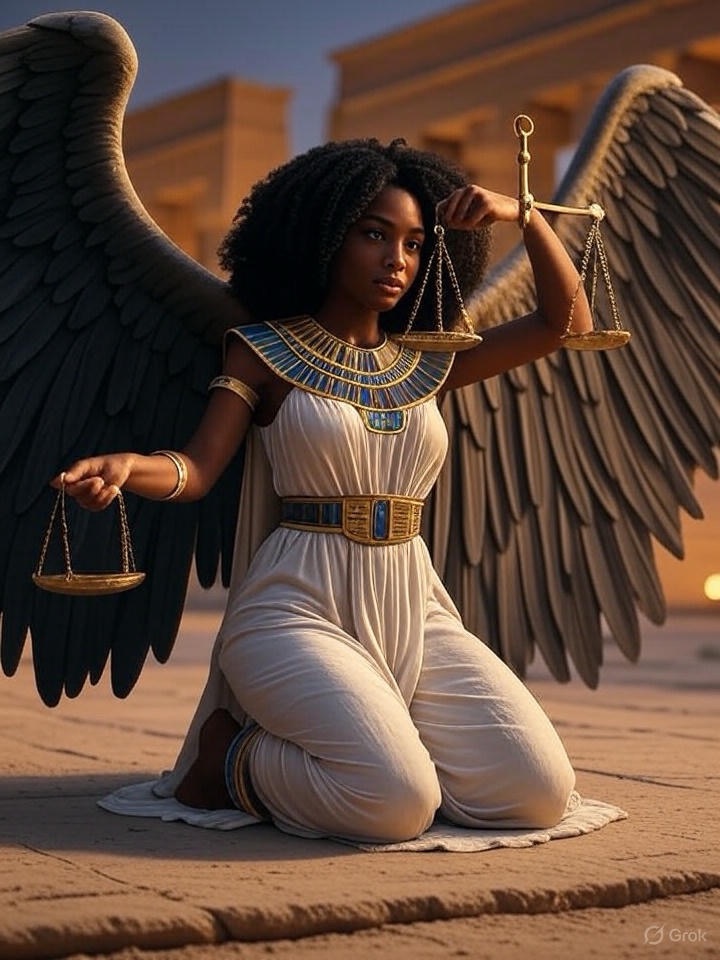
AI -Generated Image
In the Kemetic tradition, Ma’at is both a goddess and a universal principle. She represents the divine order that governs the universe—the balance between chaos and peace, ego and humility, action and consequence. She is the heartbeat of morality, symbolized by the ostrich feather, against which every soul’s heart is weighed in the afterlife.
To live in Ma’at is to live in harmony—with nature, with our communities, and with our own souls.
📜 The 42 Negative Confessions: A Sacred Mirror
The “Negative Confessions” (also known as the Declarations of Innocence) are not so much prohibitions as they are affirmations of ethical integrity. Each begins with “I have not…” and is a declaration that one has lived in truth, without violating spiritual or moral laws.
Here are a few examples:
I have not committed sin. I have not stolen. I have not slain men or women. I have not uttered lies. I have not polluted the earth. I have not closed my ears to the truth. I have not acted with arrogance. I have not caused pain. I have not neglected my responsibilities.
In total, there are 42 declarations, addressing how we treat others, how we honor the environment, how we handle power, and how we care for ourselves.
🛕 A Blueprint for Living with Integrity
These confessions offer more than religious dogma—they are a daily spiritual practice. A mirror we can hold up to ourselves to check whether our thoughts, words, and actions are in alignment with what is just, kind, and true.
To live by the 42 Confessions is to:
Cultivate Self-Awareness – Regularly examine your intentions and behavior. Practice Personal Accountability – Take ownership of your choices without blame or denial. Respect Others Deeply – Honor the dignity of every person you encounter. Care for the Earth – Treat nature as sacred, not as a resource to exploit. Balance the Inner and Outer – Align your inner world with how you show up in the outer world.
This ancient code reminds us that spiritual evolution requires ethical grounding. There can be no enlightenment without integrity. No peace without justice. No balance without accountability.
✨ Harmony with the Divine, Nature & Each Other
When we live in Ma’at, we don’t just become better individuals—we contribute to a more just and peaceful world. Our relationships improve. Our communities heal. Our connection to nature deepens. We begin to operate not from fear or selfish gain, but from reverence for the sacred interconnectedness of all life.
Imagine a world where leaders, institutions, and everyday people reflected on these confessions daily. How many injustices could be avoided? How much collective healing could take place?
🕎 From Kemet to Sinai: The Roots of the Ten Commandments
It’s no coincidence that the Ten Commandments of Moses bear a striking resemblance to the 42 Confessions of Ma’at. In fact, many scholars agree that Hebrew spiritual traditions—including elements of the Torah—were deeply influenced by the Kemetic mystery schools and moral philosophy.
When Moses fled Egypt and later received the commandments on Mount Sinai, he carried with him the memory of a society shaped by Ma’at. Concepts such as “Thou shalt not steal,” “Thou shalt not kill,” “Thou shalt not bear false witness” all echo earlier Kemetic teachings.
This cross-pollination of sacred ethics is a powerful reminder: Africa is the cradle of spiritual law. Many of the world’s great moral systems—including Judaism, Christianity, and Islam—are rooted in principles that first flowered along the banks of the Nile.
🌿 How to Integrate Ma’at into Your Daily Life
1. Morning Reflection
Choose 3–5 confessions each morning and use them as affirmations or points of self-inquiry.
2. Evening Review
Before bed, reflect: Where did I walk in Ma’at today? Where did I falter? What can I restore tomorrow?
3. Community Accountability
Share the confessions with friends, family, or a spiritual group. Use them to foster deeper conversation and collective growth.
4. Environmental Reverence
Honor Ma’at by caring for the earth. Recycle. Conserve water. Plant something. Bless the natural world.
5. Practice Truthfulness
Commit to speaking truth—especially to yourself. Let honesty become a spiritual discipline.
🧭 In Closing: The Feather and the Heart
In the Hall of Ma’at, each soul’s heart is weighed against her feather. A heavy heart—full of lies, cruelty, or injustice—cannot pass into peace. A light heart—free from harm and aligned with truth—journeys into eternal harmony.
What would it take for your heart to be light as a feather?
What must you release? What must you restore?
The 42 Negative Confessions are not relics of the past. They are a living, breathing invitation—to walk in truth, to build a life of integrity, and to remember who we truly are:
Beings of divine order, born to live in balance with all that is sacred.
As a Christian who practices both indigenous customs and spiritual healing, I encounter debates about the Old Testament laws, particularly those in Deuteronomy, and how they apply to us today. Fundamentalist Christians frequently quote these laws from the Bible to condemn practices like divination and witchcraft. But is this interpretation accurate?
Let’s take a deeper look at the origins of Deuteronomy and its relevance to modern believers.
The Historical Context of Deuteronomy
The Book of Deuteronomy was written during a critical period in Jewish history: the Babylonian exile. After Jerusalem fell to Nebuchadnezzar’s forces, many were taken into captivity, including the royal family and men of rank. The remaining Jewish leaders, particularly the priests, rewrote the Mosaic law during this time.
Why did they do this? They hoped that stricter adherence to God’s laws would prevent future disasters. The Jewish people had strayed from God, embracing idolatry and the practices of surrounding nations. The priests sought to realign the people with God’s covenant.
The laws in Deuteronomy addressed a variety of issues, including witchcraft, unclean food, idolatry, sexual immorality, and social justice. These commandments were tailored for the Jewish nation, particularly the tribes of Judah and Benjamin, who remained after the northern kingdom was scattered.
Occult Practices Outlawed
Picture Courtesy of Pexels.com
Commonly quoted scriptures include Deuteronomy 18:9-13 regarding occult practices
9 When you enter the land the Lord your God is giving you, do not learn to imitate the detestable ways of the nations there. 10 Let no one be found among you who sacrifices their son or daughter in the fire, who practices divination or sorcery, interprets omens, engages in witchcraft, 11 or casts spells, or who is a medium or spiritist or who consults the dead. 12 Anyone who does these things is detestable to the Lord; because of these same detestable practices the Lord your God will drive out those nations before you. 13 You must be blameless before the Lord your God.
I am particularly interested in the concepts of divination, sorcery, interpreting omens, witchcraft, casting spells, being a medium, a spiritualist and consulting the dead. These are practices that have been used by indigenous healers across the world, particularly in Africa for thousands of years.
It is important to note that Christianity as a religion is only about 2000 years old and came out of Judaism, which came from the Chaldean religion in ancient Babylon, which in turn came from the mystery schools of Kemet, what is known as ancient Egypt in Africa. The imposition by Christianity of Mosaic law on Africans is akin to a child once grown to adulthood instructing the elders who raised him on how they should behave.
Definitions in Terms of Etymology
If we look at the definitions based on etymology which is the study of the origins of words, we begin to understand the purpose of the rule and the agenda of the religious authorities that it was intended to drive.
The word witchcraft is derived from the Old English words wiccecræft “witchcraft, magic,” from wicce (see witch) + cræft “power, skill” (see craft).
According to etymonline.com OED says of uncertain origin; Liberman says “None of the proposed etymologies of which is free from phonetic or semantic difficulties. The word wicce is used for “a woman who practices “incantations,” and scinlæce “female wizard, woman magician,” from a root meaning “phantom, evil spirit.”
Another word that appears in the Anglo-Saxon laws is lyblæca “wizard, sorcerer,” but with suggestions of skill in the use of drugs, because the root of the word is lybb “drug, poison, charm”
From what is defined here, the original meaning of the word witch was one who used incantations and cast spells to command evil spirits to commit harm as well as one skilled in the use of drugs, poisons or charms made from herbs for maleficent purposes. This is not what African indigenous healers do. However the word came to be applied to anyone who practised a religion that had been suppressed by the authorities.
When we look up the word divination, it says late 14c., divinacioun, “act of foretelling by supernatural or magical means the future, or discovering what is hidden or obscure,” from Old French divination (13c.), from Latin divinationem(nominative divinatio) “the power of foreseeing, prediction,” noun of action from past-participle stem of divinare, literally “to be inspired by a god,” from divinus “of a god,” from divus “a god,” related to deus “god, deity” (from PIE root *dyeu- “to shine,” in derivatives “sky, heaven, god”). Related: Divinatory.
This is interesting because when Jesus Christ met the Samaritan woman at the well in John 4:18 and told her that she had had 5 husbands and that the man that she was living with was not her husband, that was a form of divination.
Another word we need to consider is necromancy. According to etymonline.com, “c. 1300, nygromauncy, nigromauncie, “sorcery, witchcraft, black magic,” properly “divination by communication with the dead,” from Old French nigromancie “magic, necromancy, witchcraft, sorcery,” from Medieval Latin nigromantia (13c.), from Latin necromantia “divination from an exhumed corpse,” from Greek nekromanteia, from nekros “dead body” (from PIE root *nek- (1) “death”) + manteia “divination, oracle,” from manteuesthai “to prophesy,” from mantis “one who divines, a seer, prophet; one touched by divine madness,” from mainesthai “be inspired,” which is related to menos “passion, spirit” (see mania). The spelling was influenced in Medieval Latin by niger”black,” perhaps on notion of “black arts” although in Latin the word also was used to signify death and misfortune. The modern English spelling is a mid-16c. correction”
When it comes to African indigenous spiritual practices, the understanding of the concept of death is important. To Africans, the physical body dies but the spirit is eternal. A healer receives their spiritual gifts and hidden information by supernatural means from spirit guides, some of whom are their blood ancestors that have transitioned and are living as spirits in another dimension. The western concept of the dead being gone is not what Africans believe.
It is interesting that in the Bible when Moses and Elijah appear to Jesus Christ before the Crucifixion in Matthew 17:4 and Peter offers to build 3 shelters for them. Christians deny the existence of ancestors as living in spirit yet recognise that Moses and Elijah who had been dead for a very long time, appeared before Jesus Christ on the mountain in the story of the transfiguration. This is contradictory. It would seem when ancestral spirits manifest among the living, for Christians, these are demons yet scripture documents the appearance of spirits of the dead to Jesus Christ.
The definition of a spiritualist is 1852, “one who believes in the ability of the living to communicate with the dead via a medium,” from spiritual + -ist (also see spirit (n.)). Earlier (1640s) “one with regard for spiritual things;”
Jesus Christ was a spiritualist. He had the ability to communicate with spirits of the dead and demons. He was able to raise people from the dead by commanding the person’s spirit to re-enter the body after it had departed and the person was declared dead. He was able to send a legion of demons into a herd of pigs that ran off a cliff and drowned themselves. If we follow the definition of a spiritualist and apply the laws if Deuteronomy, it means Jesus Christ broke the law. If Christ could break it to save people, why should others keep the law if it is not beneficial for the living?
When we study the etymology of the words used to described practices condemned in Deuteronomy 18 and we begin to analyse these practices in the context of Jesus’ Christ mission and works, they are not very different to what indigenous healers have done for thousands of years and continue to do today within and outside the Christian faith.
Do These Laws Apply to Christians?
Picture Courtesy of Pexels.com
In my opinion, if you are not of Jewish descent, the laws in Deuteronomy do not directly apply to you. If you are a born-again Christian, you are called to live under grace, not the law. The law includes the 10 Commandments given to Moses as well as the expansion of the Law within the first 5 books of the Old Testament, including Exodus, Leviticus and Numbers.
Living under grace doesn’t mean ignoring moral accountability. It means allowing the Holy Spirit to guide and convict you. As Christians, we must exercise wisdom, repentance, and restraint, as Paul emphasizes in 2 Timothy 2:24:
“God’s servants must not be troublemakers. They must be kind to everyone, good teachers, and very patient.”
However, in my experience and observation, modern fundamentalist Christians tend to be the biggest trouble-makers, deeply intolerant of other peoples’ beliefs, quarrelsome, arrogant and domineering. They are unable to exercise the necessary patience to teach and do the mission of preaching the gospel more damage with their attitude.
The Role of Discernment in Spirituality
Many fundamentalists rely on a limited understanding of the occult, often shaped by inadequate teachings. Many Christian’s comment on indigenous spiritual practices which they have never participated in or experienced. Ironically, some preachers who condemn occult practices are known to secretly consult practitioners of the occult.
It’s crucial to approach spirituality with critical thinking, research, and discernment. The Bible itself contains esoteric knowledge, much of which has roots in ancient traditions like the Kemetic mystery schools. This doesn’t mean embracing all occult practices but understanding that the Bible’s teachings often reflect deeper spiritual truths.
A Modern Reflection on Hypocrisy
Throughout history, even after rewriting the law, the Jewish people struggled with idolatry, adultery, and social injustices. Similarly, colonial powers established churches and promoted Christianity while perpetuating oppression, violence, and exploitation.
Today, prosperous nations like India and China often operate outside the constraints of colonial religious control. Meanwhile, Western nations continue to embed ancient occult practices and symbols in their institutions, from planning of government ceremonies to architecture.
The Call to Grace and Truth
Picture courtesy of Pexels.com
Jesus offered a new way. When He spoke to the Samaritan woman at the well, He didn’t condemn her for her past. Instead, He offered her “living water”—a life transformed by the Holy Spirit.
As Christians, we’re called to the same standard of grace and truth. Judging others based on Old Testament laws while claiming salvation by faith is contradictory. Jesus reminded us to judge not, lest we be judged by the same standard.
When the Pharisees brought a woman accused of adultery before Jesus, He responded, “Let the one without sin cast the first stone.” This profound lesson should guide us in how we approach faith, others, and ourselves.
Moving Forward with Discernment
In today’s world, false prophecy and deception are rampant, especially on social media. It’s easy to be swept up in popular narratives about spirituality and religion often based on a limited understanding of the spiritual practices of others. But as followers of Christ, we are called to seek truth through the Holy Spirit.
By embracing grace, practicing discernment, and striving for a deeper understanding of God’s Word through study and practice, we can live authentically in our faith. Let us move forward in the journey of faith with wisdom, humility, and a commitment to truth and compassion.
I attended the recently introduced African Contemporary Service at Northrand Methodist Church today. With hymns and choruses sung in IsiXhosa and SeSotho, there’s nothing like worship in African languages. We worshippers are never at a loss, as long as there is music and the Wesleyan Methodist Church is one of the most musical of congregations.
The sermon was an amazing God moment for me, having recently assumed a more senior leadership position. Titled the Marks of a Christian Leader, it was to celebrate the induction into leadership of oMama bo Manyano, the Women’s Fellowship. The ladies were resplendent in their red, white and black uniforms, taking the oath of office to serve in the Executive Committee. Rev. Mntambo was in his element, effortlessly switching from IsiXhosa, to IsiZulu then SeSotho and mixing it with English. He exhorted the ladies to lead like Jesus Christ.
Marks of a Christian Leader
Firstly a leader must build a team, a group of people working together for a common purpose. A leader takes responsibility for every member of the team. After calling the disciples, Jesus was committed to their welfare. In John 17, he prayed for them. You must pray for your team members if you are a Christian leader.
It’s easy to lead with your title, if you have the position and authority. However, it’s not easy to lead by character. People will obey a title but they will follow a character. A leader should be loving, humble, kind and gracious for people to follow. When you lead by title, people will do the work when you are there and stop when you are not there. When people don’t follow you, they speak ill of you when you aren’t there. Lead by character not by title.
When the team members are expected to give 100%, a leader gives 110%. A leader must inspire their followers. The word inspiration comes from the same root word as that of spirit. As a leader you must breathe into people, your life, your character and influence. A leader is one who can show the way to others. If you don’t know the way, find the way. Depend on Jesus, He knows the way, because He is the way, the truth and the life. One shows the way he or she has walked. If it’s uncharted territory, he or she must move forward into the unknown with confidence. Focus on God who has called you and not the situation or other distractions in the environment.
Leadership and Perfection
Leaders are not perfect. Take the example of David, King of Israel who committed adultery, then plotted to have the woman’s husband killed. However God did not remove him from leadership. Paul, a sinner and a zealot who persecuted and arrested Christians was called by God, and became the greatest apostle. Peter, his life was a comedy of errors, saying and doing what was inappropriate all the time. On the mountain when Jesus was praying, he wanted to stay in the glory of God and suggested building 3 shelters, one for Jesus, another for Moses and another for Elijah. When you experience the glory of God, you need to take the glory with you to the valley, to the sick, the lonely, to those that need his love. Don’t keep it for yourself.
What does God require of a Christian Leader?
Firstly, true spirituality. Be filled & controlled by the Holy Spirit. If Jesus depended on the Holy Spirit, who are you not to be? To fill your life with the Holy Spirit you must look upwards like a nestling waiting to be fed. Pray for the Lord to fill you with the Holy Spirit so you may live and lead. Secondly, be humble. Leaders must serve. The greatest shall be the least. God will elevate you. When God calls you to lead, no one can stop you.
What are the Marks of a False Leader?
A false leader joins a group for personal gain. He or she seeks a position for himself or herself. A false leader wants to occupy all positions and doesn’t want anyone else at the top. He or she uses other people as stepping stones to take him or herself to the top. Such leaders causes conflict within the team, and are constantly finding fault with other people.
A True Leader
A true leader led by the Spirit knows how others are feeling. He or she communicates with the people. They do not let problems simmer. If you see a problem deal with it kindly & graciously. A true leader asks what is wrong, not who is wrong. When you blame people for mistakes, your organisation does not grow. True leaders serve, like Jesus, who washed his disciples’ feet. He does not expect to be served. Lead by character and not title so people can follow you.
Scripture Reading Matthew 23:1-12
“Then Jesus said to the crowds and to his disciples: “The teachers of the law and the Pharisees sit in Moses’ seat. So you must be careful to do everything they tell you. But do not do what they do, for they do not practice what they preach. They tie up heavy, cumbersome loads and put them on other people’s shoulders, but they themselves are not willing to lift a finger to move them. “Everything they do is done for people to see: They make their phylacteries wide and the tassels on their garments long; they love the place of honor at banquets and the most important seats in the synagogues; they love to be greeted with respect in the marketplaces and to be called ‘Rabbi’ by others. “But you are not to be called ‘Rabbi,’ for you have one Teacher, and you are all brothers. And do not call anyone on earth ‘father,’ for you have one Father, and he is in heaven. Nor are you to be called instructors, for you have one Instructor, the Messiah. The greatest among you will be your servant. For those who exalt themselves will be humbled, and those who humble themselves will be exalted.”
Jesus talks about the Pharisees and their strict observance of religion. How did they became this way. To understand them better, we need to go back in time.
The Jews were a people set apart with to their belief in one God and their observance of the law. God gave Moses the Law, who gave it to Joshua, who gave it to the elders, the elders gave it to the prophets and it was passed down by the priests to pthe Pharisees who gave it to the people. Therefore they stood in the place of Moses as teachers of the law.
The law was first written in the time of David and Solomon from about 1000 BC. The 10 tribes broke away from the northern kingdom of Samaria during the time of King Rehoboam, Solomon’s son. Only tribes of Judah and Benjamin remained in the Southern Kingdom. The Northern kingdom was invaded by Assyria, (Sargon and Sennacherib) and the people carried off into exile in 740 BC. The Southern kingdom was invaded by the Babylonianians in 604 -586 BC. After this, the priests studied and reinterpreted the law of Moses in the light of the disaster and wrote the books of Deuteronomy and Leviticus, to ensure that people kept the law of the Lord, so that this disaster may never come upon them. There was the return from Exile in 450BC and the dedication of the Law to ensure that people understood and kept the law.
The Pharisees took the Study of the law to a whole new level, particularly after, when Antiochus Epiphanes tried to destroy the Jewish religion in 175BC by introducing the Greek religion. He introduced the sacrifice of pigs and set up an idol of Zeus in the temple. This was what was called the abomination that causes desolation.
In response to this, the Pharisees emphasized keeping themselves separate and wrote down and obeyed the letter of the law in order to preserve it. That is how they became purists, regarding the law.
Main Body
William Barclay writes this of the Pharisees: ‘The Pharisees then were two things. First, they were dedicated legalists; religion to them was the observance of every detail of the Law. But second–and this is never to be forgotten–they were men in desperate earnest about their religion, for no one would have accepted the impossibly demanding task of living a life like that unless he had been in the most deadly earnest. They could, therefore, develop at one and the same time all the faults of legalism and all the virtues of complete self-dedication. A Pharisee might either be a desiccated or arrogant legalist, or a man of burning devotion to God.’ http://www.studylight.com
According to William Barclay, The Talmud described seven kinds of Pharisees:
There was the Shoulder Pharisee. He was meticulous in his observance of the Law; but he wore his good deeds upon his shoulder. He was out for a reputation for purity and goodness. True, he obeyed the Law, but he did so in order to be seen of men.
There was the Wait-a-little Pharisee. He was the Pharisee who could always produce an entirely valid excuse for putting off a good deed. He professed the creed of the strictest Pharisees but he could always find an excuse for allowing practice to lag behind. He spoke, but he did not do.
There was the Bruised or Bleeding Pharisee. The Talmud speaks of the plague of self-afflicting Pharisees. These Pharisees received their name for this reason. Women had a very low status in Palestine. No really strict orthodox teacher would be seen talking to a woman in public, even if that woman was his own wife or sister. These Pharisees went even further; they would not even allow themselves to look at a woman on the street. In order to avoid doing so they would shut their eyes, and so bump into walls and buildings and obstructions. They thus bruised and wounded themselves, and their wounds and bruises gained them a special reputation for exceeding piety.
There was the Pharisee who was variously described as the Pestle and Mortar Pharisee, or the Hump-backed Pharisee, or the Tumbling Pharisee. Such men walked in such ostentatious humility that they were bent like a pestle in a mortar or like a hunch-back. They were so humble that they would not even lift their feet from the ground and so tripped over every obstruction they met. Their humility was a self-advertising ostentation.
There was the Ever-reckoning or Compounding Pharisee. This kind of Pharisee was for ever reckoning up his good deeds; he was for ever striking a balance sheet between himself and God, and he believed that every good deed he did put God a little further in his debt. To him religion was always to be reckoned in terms of a profit and loss account.
There was the Timid or Fearing Pharisee. He was always in dread of divine punishment. He was, therefore, always cleansing the outside of the cup and the platter, so that he might seem to be good. He saw religion in terms of judgment and life in terms of a terror-stricken evasion of this judgment.
Finally, there was the God-fearing Pharisee; he was the Pharisee who really and truly loved God and who found his delight in obedience to the Law of God, however difficult that it might be. Of the seven, six were all about the show, only one truly delighted in God’s law and in obedience.
Leadership is a form of service. The purpose of a leader is to provide a vision, guidance, direction, to motivate and encourage people to do great things and be great.
The Pharisees were leaders in Israel. They played a every important role, to bring people closer to God, through teaching them to obey the law as an act of love for God. They failed, because their leadership was self-serving. Matthew 15:8-9 says, ‘these people honour me with their lips but their hearts are far from me. They worship me in vain; their teachings are merely human rules.’ Jesus condemned them, because their obedience to the law was not out of love for God, for the most part.
Jesus deplores the hypocrisy of the Pharisees. The word hypocrite comes from a Greek word: hupocrites which means to wear a mask and play a role. It was all an act, all for show. So he says do as they say, i.e. Obey the law, but, not as they do, i.e. to make a great show of their obedience. Jesus encourages the disciples to be humble and serve each other. He illustrates this by washing their feet. He led by example, and performed miracles and taught the word out of love for God, not to be seen by men. He continued in his service unto death, even when his disciples had abandoned him. He was genuine, not playing a role.
There is a lot of talk about leadership these days. But there is a growing recognition of effective leadership as being a role that serves a purpose. If we bring it back to our country, we lack leadership in business and in politics and even in some churches, because the actions of the leadership are self -serving. We have leaders who:
o Want to be rich and live lavishly at all costs
o Are prepared to subvert justice and bend the law in pursuit of power and wealth to keep their ill-gotten gains,
o Persecute those who speak out against them
o Love the limelight, always posting on social media
o They spout ideology, anti-crime, anti-corruption, etc. Lots of talk, no action, so they do not practice what they preach.
King Solomon writes in Ecclesiastes that there is nothing new under the Sun. Even in Old Testament times, priests were expected to serve God and their to lead the people. The Lord killed both of Eli’s sons Hophni and Phineas because they abused their positions as priests. When Eli died, he was replaced by Samuel. Samuel was tireless in his service.
What God desires is obedience, not sacrifice (1 Samuel 15.22) and service to others out of love. Do nothing out of selfish ambition. Consider others better than yourself (Philippians 2.3)
Conclusion
True leadership is an act of service, to God and to Men. If you are in a position of leadership, ask yourself whom are you serving?
If you want people to follow you, you must serve them, Jesus does so much for people. As a result huge crowds followed him. How does your leadership serve the purpose of God. How does it serve those whom you lead? I encourage all of us to model our leadership according to the pattern of Jesus Christ and to ask the Holy Spirit to guide us . Let us pray for all our leaders to be authentic and humble, to have a sevant’s heart and a teachable spirit, subject to the authority of God. Only then can we live in peace and prosperity in harmony with God and with each other.



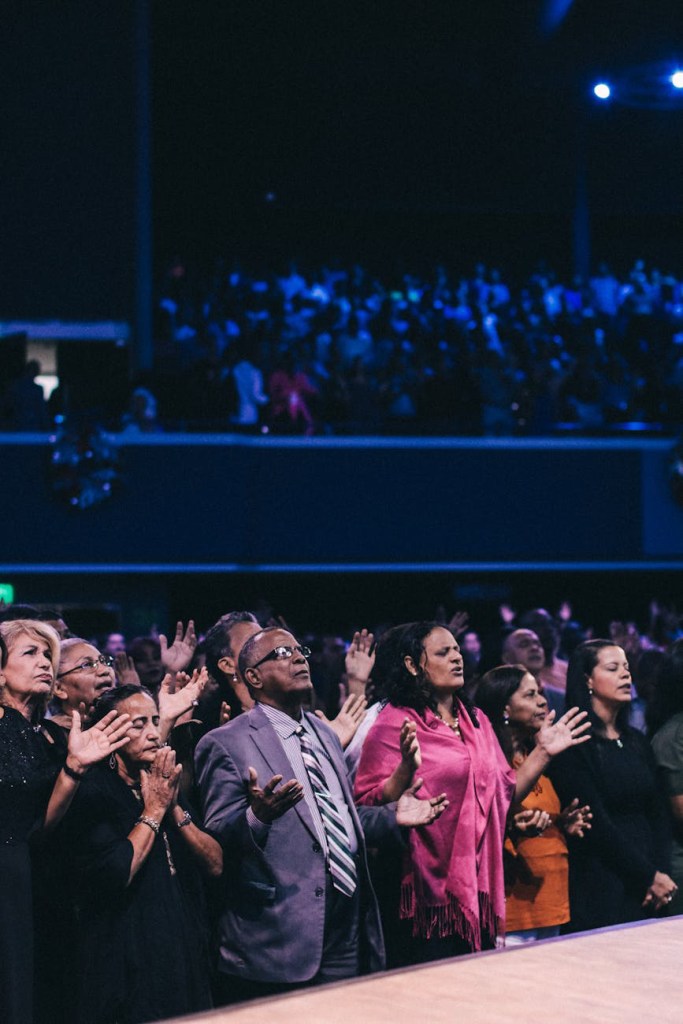

 I attended the recently introduced African Contemporary Service at Northrand Methodist Church today. With hymns and choruses sung in IsiXhosa and SeSotho, there’s nothing like worship in African languages. We worshippers are never at a loss, as long as there is music and the Wesleyan Methodist Church is one of the most musical of congregations.


You must be logged in to post a comment.