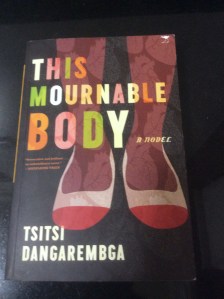
Book Review: This Mournable Body by Tsitsi Dangarembga

By Nomathemba Pearl Dzinotyiwei

The novel is set in Zimbabwe in the 2000s. The economy is ruined and the populace are scrambling for what few opportunities are left for survival in the city. Smart office buildings in the city now house a motley assortment of small businesses providing different goods and services, whatever is in demand at the time. However bad things are in the city, they are worse in the village as few city dwellers can afford trips home or to send much-needed money and groceries. Yet with their generosity of spirit, people from the village send a share of their produce to help out family members in the city. Tambudzai Sigauke, the protagonist must use her wits to survive in the city. Degreed but unemployed like hundreds of thousands of others, she has to make her way in the unforgiving city environment, get a place to lay her head, feed herself and find her way back to the prosperity she feels entitled to, all without completely losing her mind.

If you ever lived in Harare any time after the year 2000, you can relate to this story. The looming possibility of descending into the ignorant bliss of lunacy is ever-present in a country where nothing makes sense. The narrowing range of choices and unspeakable deeds some people contemplate and others do in order to keep the wolf from the door are only things people in a post-conflict economy in a developing nation can understand. Zimbabwe may not have been at war with another nation, but the war by the state against its citizens continues unabated to this day.

This novel written in the second person, by the narrator taking a dispassionate look at Tambudzai and the choices she makes, that precipitate chaos within and around her. This is a novel that will need you to dig deep into the well of your English vocabulary and occasionally look up a few words. The expressions are an interesting, rendering of Shona to English, attempting to express the meaning without necessarily using direct translation. Being Zimbabwean, I easily recognise the stories, songs and the expressions that are particular to the Manyika dialect spoken in the Eastern region. This novel could easily be translated into Shona with no loss of depth meaning. Perhaps one day, there will be someone courageous enough to do that for all three of the novels in the trilogy. Our languages carry an entire knowledge system, which if we don’t preserve them, will completely disappear.

The story is a haunting testament to the women of our country who stand strong despite violence, abuse, poverty and deprivation but soldier on and triumph over circumstances that have broken people with a less robust mental constitution. The men are there, but not there, battling demons of their own, powerless over the circumstances that reduce them and sadly taking out that frustration on the women. Thank you Tsitsi for telling the story of our mothers, our sisters, the story of the women that endure to birth the future. May that future be a better one.

Poverty, Violence and Crime in SA. What Can We Do About it?

By Nomathemba Pearl Dzinotyiwei
It pains me to write this. SA is a beautiful country. But the contrasts are hard to ignore. The ultra-rich 1%, the better off 9% that manage on credit & the 90% that are not able to make ends meet. We complain about crime, violent protests & derelict infrastructure. How did we get here? When we talk of apartheid and colonialism, people want to shut it down and say ‘get over it’. But it’s not over. Both had a terrible & lasting impact on the psyches of Black people which will take generations to erase. The violence & crime we see today is a direct result. 
The violence and oppression of Black people in South Africa because is now manifesting as violent crime such as robbery, rape etc. Black men felt powerless & took their emotions out on women & children, those weaker than them. They turn on foreigners for the same reason. The violence of the protests is a result of not being heard until essential infrastructure is damaged.
Black people have been underpaid and many still are, compared to white people in the same jobs. If you don’t pay the parents a living wage, they can’t feed their children properly. Inadequate nutrition & mental stimulation before age 3 leads to irreversible brain damage. Research has shown that poor people live under unremitting stressful conditions which lead them to make poor decisions of the short-term kind. They are unable to plan beyond getting the next meal by any means available. Those people unfortunately are the majority of the 90%.
Captains of industry complain that there are no skills in engineering, science & maths. Where will the skills come from? The people do not have the capacity to learn due to childhood malnutrition, because their parents were poorly paid plus they had ill-equipped schools. The same people complain about crime & how it deters investors. They refuse to connect their desire for short- term profit 2 generations ago to the social problems that we see today. They pretend that everyone has the same 24 hours & equal opportunity while bypassing BEE rules. 
There are no easy solutions. I agree with Professor Mamokgethi Phakeng  @UCT_VC calling for a wealth tax on the 1%. The 9% are burdened by income and value-added tax which take up a significant portion of their income. The wealthiest 1% do tax planning and manage to get away with legal avoidance of taxes because they can afford professional tax advice. The project for national renewal needs funding.
We need sound ethical leadership at all levels of society. The focus on short-term profit needs to be done away with. Shareholders who put pressure on businesses to make a profit at all costs are equally responsible. Naturally they belong to the 1%. The same shareholders look the other way when their executives bribe or make “facilitation payments” to get government business. The culture of corruption in the public sector is not a post-apartheid phenomenon. However our leaders learned from the best and have taken corruption to another level. Now there is nothing left to steal.
We can start by ensuring children are properly fed & early childhood learning centres are built. Then we can stop manufacturing criminals. This requires parents who are working to be paid a living wage. It’s a no- brainer. The multiplier effect alone of improving workers’ incomes will create a bigger more profitable market in the long run for business.
To address the issue of violence, we need conflict resolution work & debriefing to happen in our townships and schools to enable people to solve problems without resorting to violence. The work that Forest Whitaker @ForestWhitaker is doing with his foundation in the Cape flats is commendable. We need more of that. 
60% of households in SA do not own a book. Only 14% of the population read for leisure. A novel on average costs R250 in a bookshop. We need government to support the publishing industry by zero-rating VAT on books. Festivals like the Abantu Book Festival  @Abantu_ need support to build a reading culture. Because South African history is not taught in schools, works of fiction or historical novels and works of nonfiction can fill that gap. The lack of knowledge of history, whether our own i4 that of others means we are doomed to repeat the same mistakes.
The film industry can also be used to turn the culture around. Nollywood & Bollywood are the biggest film industries in the world by turnover. Investment in local films to provide entertainment and facilitate a culture change. Mobile cinemas can help reach people in remote areas. If we can make films that show what South Africa can be to the younger generation, then we have a chance to re-engineer the national psyche to create our best selves.
Government needs to be serious about creating employment for adults without STEM skills. It’s no use talking about 4IR in a developing country without basic infrastructure, roads, railways, bridges, water and electricity. That work can be done by unskilled people, just pay them. If you keep them busy and pay them well, then they can look after their families and not be tempted to rob, rape and kill.
If you don’t want crime, then stop creating fertile conditions for it, Incidentally among the 1% are those making money from the drug trade, trafficking of stolen goods & human trafficking. They too are responsible for corrupting government officials, who then look the other way as they continue with their nefarious activities. Luckily for them, they can afford armed private security & sip champagne & cognac behind high walls & gates. They can scoff at ‘the wretched of the earth’ but there will come a time when all that money will not save them, when social systems collapse completely.

The legacy of violence created by colonialism and apartheid will continue until the cycle is broken. There can be no freedom or security is the majority of the people are living in poverty & fighting for the scraps. Breaking that cycle requires conscious and ethical leadership that is prepared to do the right thing for the greater good. SA is not irretrievably broken at this point, however the longer we wait, the close we edge towards being a failed state. The country north of the border is almost there. South Africa is not special, no matter how highly we think of ourselves, it can happen here too. It’s not too late to stop it. Our future depends on what we do now.

Requiem for Old Bob

“Robert Mugabe

The former President of Zimbabwe has died”

A voice intoned over the radio.

I waited for the shock of loss.

None came.

I thought somewhere,

in the dark corners of my deeply scarred soul,

I would find at least a shadow of grief.

There was none.

I waited for the tears to come.

But there was nothing.

No lachrymose outpouring of grief.

They were long gone.

Shed over the years

For the unhealed wounds of my people

Dealt by that despot

Named for an angel

One of the best and brightest

God’s own messenger.

Who instead trafficked in death

It makes me angry

That he’s gathered peacefully to rest

With his forefathers

Leaving in his wake

A nation destroyed for generations.

Death was too good for him.

The nation cheated of retribution

What about the thousands?

Dead in mass graves in Matebeleland.

The car accidents?

Loved ones vanished without a trace,

Their bodies dissolved in acid.

A literate people dying of cholera in the city and

Of HIV AIDS in the village.

What about the millions?

Dead men walking, without hope, without God

Women raped, the scars on their souls

Veiled with hysterical laughter.

What about the billions

Embezzled & stashed outside the country.

Broken families scattered across a world.

Of increasingly hostile nations

Anxiously making a living.

What about the parents they cannot bury,

The children they cannot raise,

Beloved spouses parted by distance not death.

How dare he die?

Leaving us to live

With the consequences of his misrule.

There are others more deserving

Of my grief

The ones sacrificed

For his bloodthirsty lust for power

There’ll be no elegy for him.

No tears for old Bob.

©️ Pearl Deyi 2019

The Mark of a Christian Leader

By Nomathemba Pearl Dzinotyiwei

I attended the recently introduced African Contemporary Service at Northrand Methodist Church today. With hymns and choruses sung in IsiXhosa and SeSotho, there’s nothing like worship in African languages. We worshippers are never at a loss, as long as there is music and the Wesleyan Methodist Church is one of the most musical of congregations.

The sermon was an amazing God moment for me, having recently assumed a more senior leadership position. Titled the Marks of a Christian Leader, it was to celebrate the induction into leadership of oMama bo Manyano, the Women’s Fellowship. The ladies were resplendent in their red, white and black uniforms, taking the oath of office to serve in the Executive Committee. Rev. Mntambo was in his element, effortlessly switching from IsiXhosa, to IsiZulu then SeSotho and mixing it with English. He exhorted the ladies to lead like Jesus Christ.

Marks of a Christian Leader

Firstly a leader must build a team, a group of people working together for a common purpose. A leader takes responsibility for every member of the team. After calling the disciples, Jesus was committed to their welfare. In John 17, he prayed for them. You must pray for your team members if you are a Christian leader.

It’s easy to lead with your title, if you have the position and authority. However, it’s not easy to lead by character. People will obey a title but they will follow a character. A leader should be loving, humble, kind and gracious for people to follow. When you lead by title, people will do the work when you are there and stop when you are not there. When people don’t follow you, they speak ill of you when you aren’t there. Lead by character not by title.

When the team members are expected to give 100%, a leader gives 110%. A leader must inspire their followers. The word inspiration comes from the same root word as that of spirit. As a leader you must breathe into people, your life, your character and influence. A leader is one who can show the way to others. If you don’t know the way, find the way. Depend on Jesus, He knows the way, because He is the way, the truth and the life. One shows the way he or she has walked. If it’s uncharted territory, he or she must move forward into the unknown with confidence. Focus on God who has called you and not the situation or other distractions in the environment.

Leadership and Perfection

Leaders are not perfect. Take the example of David, King of Israel who committed adultery, then plotted to have the woman’s husband killed. However God did not remove him from leadership. Paul, a sinner and a zealot who persecuted and arrested Christians was called by God, and became the greatest apostle. Peter, his life was a comedy of errors, saying and doing what was inappropriate all the time. On the mountain when Jesus was praying, he wanted to stay in the glory of God and suggested building 3 shelters, one for Jesus, another for Moses and another for Elijah. When you experience the glory of God, you need to take the glory with you to the valley, to the sick, the lonely, to those that need his love. Don’t keep it for yourself.

What does God require of a Christian Leader?

Firstly, true spirituality. Be filled & controlled by the Holy Spirit. If Jesus depended on the Holy Spirit, who are you not to be? To fill your life with the Holy Spirit you must look upwards like a nestling waiting to be fed. Pray for the Lord to fill you with the Holy Spirit so you may live and lead. Secondly, be humble. Leaders must serve. The greatest shall be the least. God will elevate you. When God calls you to lead, no one can stop you.

What are the Marks of a False Leader?

A false leader joins a group for personal gain. He or she seeks a position for himself or herself. A false leader wants to occupy all positions and doesn’t want anyone else at the top. He or she uses other people as stepping stones to take him or herself to the top. Such leaders causes conflict within the team, and are constantly finding fault with other people.

A True Leader

A true leader led by the Spirit knows how others are feeling. He or she communicates with the people. They do not let problems simmer. If you see a problem deal with it kindly & graciously. A true leader asks what is wrong, not who is wrong. When you blame people for mistakes, your organisation does not grow. True leaders serve, like Jesus, who washed his disciples’ feet. He does not expect to be served. Lead by character and not title so people can follow you.

Re-Member

To re-member is to put things

Back together.

To make whole

The scattered scraps of collective memory

Of who we once were.

Like dry bones of broken limbs

Strewn across the barren wasteland

Reminiscences litter the bleak emptiness

Of souls lost for generations

Desperate to forget yet recall

A past buried under a weight of pain

Replete with hopes and dreams,

Recollections of loved ones

Dead and unmourned,

Or left behind crying with arms outstretched.

They shuffled painfully,

Out of that dark dank little cavern

Through that little door

Of no return

To sail across water

Wetter than tears

Crying “Father!

Does your magic stretch this far

To save us.”

Tell the stories to your children

& your children’s children.

Teach them to sing

In the language of your people.

They will recall and sing

Uncomprehending

But one day

In the presence of those who know,

they will REMEMBER.

©️Nomathemba Pearl Dzinotyiwei 2019

Book Review: The Book of Dust by Philip Pullman

By Nomathemba Pearl Dzinotyiwei

A few years there was a movie called the Golden Compass, based on the work of Philip Pullman about a young girl called Lyra who owned and could read a strange instrument. She was the subject of a prophecy like Harry Potter, and this made her a person of great interest to the religious, occult and scientific communities. The climax of the movie is when she frees a great polar bear and helps him regain his magic armor which makes him invincible in the war. If you enjoyed the movie, you’ll want to read this book.

The Book of Dust, his latest work, is the first of a trilogy published in 2017 is the prequel to Lyra’s story. It tells of the inauspicious circumstances of her birth, to the beautiful, yet terrifying Mrs. Coulter and the intrepid adventurer and scientist Lord Asriel. The two were in an adulterous love affair which resulted in the fatal shooting of Mr. Coulter by Lord Asriel in a fight. Lyra is born soon after. Mrs Coulter doesn’t have a maternal bone in her body and Lord Asriel is regarded as an unfit parent. As a result the baby Lyra is taken into sanctuary by the nuns at the priory in Godstow, a small village on the banks of the River Thames. There, she forms a bond with Malcolm, the innkeeper’s son who helps the nuns on a regular basis.

The story is told from young Malcolm’s point of view. An intelligent and curious child of uncommon kindness, decency and courage, Malcolm emerges as the hero, when the forces of nature, religion and the state threaten the baby Lyra’s life. After many misadventures and gaining an unlikely ally, Malcolm and his trusty canoe called La Belle Sauvage find themselves embroiled in a web of espionage as they battle the elements, a demented ex-convict and religious fundamentalists in an effort to get Lyra to an alternative place of safety.

This is a gripping tale where the worlds of magic, reality, religion and science collide in the battle for the hearts and minds of humanity. Philip Pullman takes us back to where it all began. The cliffhanger ending is sure to make you want to read the next work of this trilogy.

Book Review: House of Stone by Novuyo Rosa Tshuma

By Nomathemba Pearl Dzinotyiwei

‘It was the best of times and the worst of times.’ This is the opening line of a Tale of Two Cities by Charles Dickens. For the Ndebele people of Zimbabwe the Gukurahundi massacres were the worst of times. The sheer violence, brutal rape and dehumanizing murders perpetrated by a black government against defenseless black civilians were unparalleled in the country’s history or indeed that of the continent at the time. It could be said that the perpetrators of ethnic violence in Rwanda and Burundi took a leaf out of Robert Mugabe & the ruling party’s playbook.

The book’s title is a direct translation of the name of the nation of Zimbabwe, derived from the mysterious monumental ruins of the capital of the pre-colonial Mutapa Empire, known as dzimba dza mabwe in the Shona language or houses of stone in English. Ironically today, the country has been deserted by the best and brightest of its citizens and the economy is literally in ruins. There are different strategies adopted by the people to survive the economic holocaust evident in the novel. One could say the country’s name is a self-fulfilling prophecy.

The novel follows the story of Zamani, the main character, a lodger in the back-room at a house in the township of Luveve, in Bulawayo, a house formerly owned by his late Uncle Fani. Zamani is an orphan, whose mother Zodwa died in the death camp of Bhalagwe during the massacres. His conception from gang rape in the camp means his father is unknown and he is searching for a father and a family. His investigations lead him to the enigmatic character known as Black Jesus, a high-ranking leader of the government forces that laid waste to the land and people of Matebeleland. He remains a key figure in the ruling party ZANU PF today, those architects of poverty and violence.

Given the denial of the atrocities by the government and having no hope of resolving the issue of his paternity, Zamani insinuates himself into the lives of the Mlambo family in an effort to create a family of his own. However just as in the book of Genesis, the blood speaks and Zamani realises that he is very much his father’s son as he plots to establish himself within the family and like any usurper, schemes to ensure that his position is unassailable.

I had the privilege of meeting the author at the Abantu Book Festival in Soweto last year. She is an erudite, bold, passionate and outspoken young woman, who despite years of living in the diaspora has not forgotten her roots.

This courageous work successfully lifts the veil of darkness on a bloody period in the nation’s history. It was not an easy read, due to the familiar hi-story thanks to hearing accounts by family and friends with first-hand experience of the massacres. However, Novuyo manages to convey the violence and tragedy of the massacres and their consequences for generations, with humour and unnerring accuracy. All the accolades she receives for this work are well-deserved. I definitely recommend this book for anyone seeking to understand the basket case that is the land of my birth, the house of stone to the north of the Limpopo River.

No Rules – Available on Amazon

This is a cross-cultural love story of two millennials set in Johannesburg, South Africa. It is available on Amazon under Women’s Fiction. To read a sample and purchase, go to https://www.amazon.com/kindle/dp/B071NY9YXC/ref=rdr_kindle_ext_eos_detail

You can check out my other posts on this blog and visit my FaceBook Page at https://www.facebook.com/lamourafricaine/

This is my first self-published novel, under the my nom de plume Pearl Deyi. Deyi is one of the family names of our clan, oManzini aba kwaZungu and also has letters from my surname.

Say No

Peace in the heart, peace in the home, peace in the world.

Princess Pearl Manzini's avatarIndulgent Gifts South Africa

Say no

To those who

Demean

Dismiss and

Disrespect you.

Say no

To those who decide

That your being different

Makes you less than the least of them

And therefore underserving of

Courtesy

Consideration and

Contentment.

Say no

To those who deny

Your right to occupy

The same space

Enjoy the latitude

To express

The essence of you.

To those who

Use and abuse you

Sacrificing your fragile wellbeing

on the altar of

Their self-centred desires

Say no.

To those

Whose good intentions pave the way

to your personal hell

Saying you must,

you should

you had better

Do whatever

hurts your body and sickens your soul

Say no.

To your ego

Which sides with the enemies outside

Refusing to honour the truth

Of who you are.

Say no.

View original post

Book Review: The Polygamist by Sue Nyathi

By Nomathemba Pearl Dzinotyiwei

Heh leh Jonasi

Heh yeh Jonasi

Loving you has taught me

To never let go of a good thing

Loving you has taught me never to lie

I hate telling a lie…

This is the beginning of Stimela’s hit song I Hate Telling A Lie with Ray Phiri as lead vocalist and on lead guitar. This song played in my head when I started reading The Polygamist, Sue Nyathi’s debut novel, centered around a rich powerful man named Jonasi. However the protagonist is nothing like the serenading lover portrayed in the song. Jonasi in the novel, lies without compunction and never stops, lying even to himself.

The story begins with the account of Jonasi’s funeral with all the women in his life gathered to bid him farewell. Jonasi in death is far from the handsome virile lover, husband and father they experienced in life. Set in Harare, Zimbabwe, the city that never sleeps, there is a grim contrast in the lives of the have-nots living in the township and the fabulously well-heeled living in the Northern suburbs. Then as the economy tanks, even the wealthy feel the pinch as everyone tries to make a living, hustling in whatever way they know how.

The story is told from the point of view of each of the women as they experience the sorrows and fleeting joys of loving a selfish man who never really belongs to any of them. In his own words, he loves each of them for very different reasons. Each of the women’s stories is different. What motivated them to get into this relationship, to stay or in some cases to leave, albeit in different ways?

The children react in different ways as each child’s dream of the perfect family is shattered by the drama in the making, unmaking and remaking of the relationships between their father and each of their mothers. The extended family have their own view of the situation and treat it with delicacy to avoid upsetting Jonasi and losing out on the benefits

The novel is a gripping read. Sue has a wicked sense of humour and the ability to get you to laugh at what are dire situations in the book. There are such gems as ‘ my wife had more game than a soccer team’ and when the youngest of the women describes the older men she slept with saying: ‘ Their asses are so wrinkled sometimes I have to ask myself if it’s flesh I’m holding onto or a mohair throw.’ If you want to see more gems, follow her on @SueNyathi on Twitter.

The Polygamist takes a brutally honest look at marriages and love affairs. It is an unforgettable read that will make you rethink relationships and people’s motivations for entering and staying in them.