By Nomathemba Pearl Dzinotyiwei
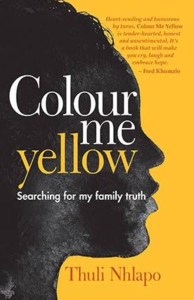
Colour Me Yellow: Searching For My Family Truth, the autobiography by Thuli Nhlapo is a compelling read. For me, an autobiography is someone else’s story. Thuli’s book is more than that. It touched me deeply because it is as much my story as it is that of many other people. The themes of Thuli’s story resonates with the story of my own family: of family secrets; the pain of being an outsider; of being different; the liberation of discovery and the realization that you have always known deep down, that which everyone around you is determined to deny. The issue of her complexion dominates the story, a reverse form of the colourism that we experience today, which glorifies light skin as a form of proximity to whiteness. There’s also the refusal by her family to acknowledge the distant past, which causes a painful prolonged and unnecessary struggle for her to integrate her intense spiritual gifts into her life.
This is a story of an African family, like many others, that keep a secret to keep them together. For the secret is like the one ring that binds them all* . It keeps the family whole, forcing everyone to maintain the façade of normalcy. What is a ‘normal’ family? Well for a start, a family must have a head. A father. The biological relationship is not a prerequisite, however, that masculine presence and influence is considered to be essential. In a generation where it was inconceivable for a woman to be independent, or to be alone by choice, a woman had to keep a man in her life, at all costs, at no matter how badly he behaved. The secret binds her to him.
Thuli’s mother is strong, yet weak, vulnerable yet invincible, at the same time. This contradiction in character is a necessity. An African mother is not only the neck that must support the head; she is the spine, the back and broad shoulders that must bear the burdens of raising a family; and take the lead in keeping that family’s place in the community. So she must be feminine and flexible enough to accept the patriarchal dictates of the husband and father of the house, yet in his absence: physically, emotionally and financially, she must be strong enough to fend for herself and her children. He like many men, comes strolling in and out of her life at his own convenience, imposing his own opinion of what should happen, regardless of the fact that he is not there to stay. It makes me exceedingly angry: that a man always has a choice and can escape responsibility without facing any consequences; while a woman is stuck with dealing with the effects of his choices for the rest of her life.
It is easy to judge Thuli’s mother for her failings and inadequacies, but as Maya Angelou put it, she did what she knew best, at that time. I believe as a mother herself, Thuli is able to write her mother’s part in the story with tenderness and compassion that comes with wisdom and the understanding that as a parent you don’t have all the answers. The story has excruciating painful episodes of abuse and cruelty that make you want to weep and hold the child that was her. Yet there are moments of tenderness, hope and joy that have you cheering for her, and for those people that, as Tyler Perry puts it, are the points of light in her life . I especially love her portrayal of rural Swati people, their simplicity, peaceful attitude and joy, something many people from more militant and aggressive societies would not understand.
You come to understand why her life turned out in the manner that it did: with her choices and the reactions of the people in her life. There are moments of divine intervention when she receives help at a time when she needs it most. She gets an education, attains professional success and acquires the car, the townhouse and the trappings of the Johannesburg yuppie lifestyle. Finally there is the journey that leads her to the truth, the unfolding of and her acceptance of who she is. It is a story much like the clumsy emergence of a butterfly from its cocoon, a painful but necessary process for it to strengthen its wings so it can fly.
Ntozake Shange, in her choreopoem For Colored Girls Who Have Considered Suicide When The Rainbow is Enuf writes:
‘Somebody/anybody
sing a black girl’s song
bring her out
to know herself
to know you
but sing her rhythms
carin/ struggle/ hard times
sing her song of life
she’s been dead so long
closed in silence so long
she doesn’t know the sound
of her own voice
her infinite beauty’
For herself, her mother, our mothers and all the women in her family and other families caught in the matrix of African traditionalist patriarchy and toxic family secrecy, Thuli Nhlapo has done just that. She has sung our song.
* A line of dialogue from Lord Of The Rings, a film adaptation of The Hobbit by J.R.R. Tolkien.

 PrincessPearlManzini
You must be logged in to post a comment.