The totally unexpected beginning of this story had me thinking ‘Who starts a novel like that?’ The closest to come to that would be how Margaret Atwood, in an ad for an online masterclass, when she says she would have rewritten the beginning of Little Red Riding Hood to say: ‘It was dark inside the wolf.’ Taiye Selasi’s technique kept me riveted for the next 318 pages.
The story draws you in to the chronicles of three generations of a family. Starting with an interracial marriage between Maud a Scotswoman and John Nwaneri, in Nigeria, their daughter Somayina, who dies young leaving her husband Olukayode Savage and their young daughter Folasade. After the tragic death of her father in an outbreak of violence in the Muslim North, Folasade emigrates to the United States of America, where she meets Kweku, a Ghanaian medical student. They get married and raise a family: Olu, who follows in his father’s’ footsteps, the twins: Taiwo, a girl and Kehinde a boy, who share that sacred bond and then Folasade, nicknamed Sadie, the last-born daughter who nearly didn’t make it.
The family’s American Dream, however, morphs into a nightmare when he fails to save the life of a millionaire’s mother, who happens to be a benefactor of the hospital. To appease the family, the hospital unjustly fires the good doctor, one of their finest surgeons and thus begins the family’s downward spiral into tragedy.
The novel, much like a movie, pans, zooms in and fades out, with flashbacks into the family’s lives as they deal with the disappearance and attempted reappearance of the husband and father from their lives after he loses his job. Folasade calls on her native Nigerian hustling instincts to pick up the pieces and keep going. Each child is affected differently and finds their own way of dealing with the separation of their parents and the impact of the decisions their mother had to make to support them.
The family reunites in Ghana many years later to bury Kweku, now a successful surgeon in a local hospital. He has remarried and built his dream home with an achingly beautiful garden, planted and tended by a geriatric yogi called Mr Lamptey, the eccentric carpenter who built the house. They all react differently on arrival in this country. It’s home, yet not home, this strange land that their father came from.
In the run-up to the funeral, the children get to know their father’s family, come to understand their father better and what drove him. They each find their own connection to this place, to begin to understand and resolve some of their personal issues, including the retelling of painful and deeply-buried secrets. In this land they begin to understand their gifts and find their place in the world. This unfolding of events gives credence to the belief that only when you know where you come from, will you know where you’re going. It partly explains Africans’ obsession with ‘going home’, especially for immigrants and their children born on foreign soil.
The most poignant part of the story is how Folasade, having moved back to Africa, mourns her estranged husband and makes peace with his new wife Ama. In one of those stories of female solidarity that is so often not told, the two women, understanding they have both lost him, mourn him together and support each other.
Ghana Must Go, makes reference to the xenophobic sentiment in Nigeria which led to the mass expulsion of Ghanaians living in the country. It is a story of personal struggle and sacrifice against the backdrop of war, poverty and making a life in a foreign land. It reveals the beauty and cruelty that comes with being part of a family as well as a personal search for belonging and a spiritual place of rest. It is an altogether unforgettable read.
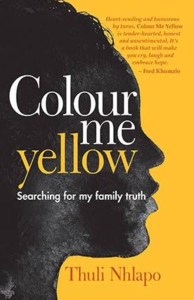
Colour Me Yellow: Searching For My Family Truth, the autobiography by Thuli Nhlapo is a compelling read. For me, an autobiography is someone else’s story. Thuli’s book is more than that. It touched me deeply because it is as much my story as it is that of many other people. The themes of Thuli’s story resonates with the story of my own family: of family secrets; the pain of being an outsider; of being different; the liberation of discovery and the realization that you have always known deep down, that which everyone around you is determined to deny. The issue of her complexion dominates the story, a reverse form of the colourism that we experience today, which glorifies light skin as a form of proximity to whiteness. There’s also the refusal by her family to acknowledge the distant past, which causes a painful prolonged and unnecessary struggle for her to integrate her intense spiritual gifts into her life.
This is a story of an African family, like many others, that keep a secret to keep them together. For the secret is like the one ring that binds them all* . It keeps the family whole, forcing everyone to maintain the façade of normalcy. What is a ‘normal’ family? Well for a start, a family must have a head. A father. The biological relationship is not a prerequisite, however, that masculine presence and influence is considered to be essential. In a generation where it was inconceivable for a woman to be independent, or to be alone by choice, a woman had to keep a man in her life, at all costs, at no matter how badly he behaved. The secret binds her to him.
Thuli’s mother is strong, yet weak, vulnerable yet invincible, at the same time. This contradiction in character is a necessity. An African mother is not only the neck that must support the head; she is the spine, the back and broad shoulders that must bear the burdens of raising a family; and take the lead in keeping that family’s place in the community. So she must be feminine and flexible enough to accept the patriarchal dictates of the husband and father of the house, yet in his absence: physically, emotionally and financially, she must be strong enough to fend for herself and her children. He like many men, comes strolling in and out of her life at his own convenience, imposing his own opinion of what should happen, regardless of the fact that he is not there to stay. It makes me exceedingly angry: that a man always has a choice and can escape responsibility without facing any consequences; while a woman is stuck with dealing with the effects of his choices for the rest of her life.
It is easy to judge Thuli’s mother for her failings and inadequacies, but as Maya Angelou put it, she did what she knew best, at that time. I believe as a mother herself, Thuli is able to write her mother’s part in the story with tenderness and compassion that comes with wisdom and the understanding that as a parent you don’t have all the answers. The story has excruciating painful episodes of abuse and cruelty that make you want to weep and hold the child that was her. Yet there are moments of tenderness, hope and joy that have you cheering for her, and for those people that, as Tyler Perry puts it, are the points of light in her life . I especially love her portrayal of rural Swati people, their simplicity, peaceful attitude and joy, something many people from more militant and aggressive societies would not understand.
You come to understand why her life turned out in the manner that it did: with her choices and the reactions of the people in her life. There are moments of divine intervention when she receives help at a time when she needs it most. She gets an education, attains professional success and acquires the car, the townhouse and the trappings of the Johannesburg yuppie lifestyle. Finally there is the journey that leads her to the truth, the unfolding of and her acceptance of who she is. It is a story much like the clumsy emergence of a butterfly from its cocoon, a painful but necessary process for it to strengthen its wings so it can fly.
Ntozake Shange, in her choreopoem For Colored Girls Who Have Considered Suicide When The Rainbow is Enuf writes:
‘Somebody/anybody
sing a black girl’s song
bring her out
to know herself
to know you
but sing her rhythms
carin/ struggle/ hard times
sing her song of life
she’s been dead so long
closed in silence so long
she doesn’t know the sound
of her own voice
her infinite beauty’
For herself, her mother, our mothers and all the women in her family and other families caught in the matrix of African traditionalist patriarchy and toxic family secrecy, Thuli Nhlapo has done just that. She has sung our song.
* A line of dialogue from Lord Of The Rings, a film adaptation of The Hobbit by J.R.R. Tolkien.
Akriti and Jennifer from the Primus Super-Speciality Hospital.
For me it was India. I always had a secret fantasy about going there. It is after all the land of Gandhi, the Taj Mahal, curry and the Kama Sutra. I’ve travelled to a number of countries for work and on holiday but quite honestly, I have never seen any country like India.
I would probably not have consciously chosen to go, had it not been for my brother needing urgent medical attention. He had Conn’s Disease, a rare condition with a growth on the adrenal gland that causes the loss of potassium in the blood, the secretion of excess aldosterone and results in asymptomatic high blood pressure. With rates as high as 200/120, high blood pressure is a silent killer that destroys organs, particularly the heart and kidneys.
India had many hospitals and specialists with the best state of the art and affordable medical care. The same surgery was going to cost us four times as much in Johannesburg and he’s not on medical aid. He lives in Zimbabwe and with the economic meltdown and lack of expertise, having the surgery done there was not an option. India however, has a booming medical tourism sector with a value chain that includes: medical professionals, hospitals, concierge services, hotels and transport companies. We were looked after from the day we arrived by two lovely young ladies called Akriti and Jennifer, from Primus Super-Speciality Hospital. Both were absolute angels. Akriti picked us up from the airport in a taxi and we went straight to the hospital.
On arrival, Jennifer, also from the International Patients Department took over, escorting us to the various departments for checkups and consultations. I knew my way around the hospital by the time we were done. They need that department because from what I saw to my shock, about 1 in 10 Indians speak English. The British left India a long time ago. There was no way we were going to get around the Hospital on our own. My brother and I saw 4 specialists that day, a urologist, an endocrinologist, a cardiologist all men, over 40 and then the anesthetist. I had to set aside my gender and ageist prejudice as I watched this ‘mere slip of a girl’ rigorously interview my brother and make notes on a massive chart. I was ready to give her a standing ovation when she was done, about 10 minutes later.
My brother was admitted that evening for observation two days before surgery. I left the hospital in the early evening and the driver dropped me off at the hotel. I checked in with minimal fuss. I paid the bill upfront for our stay, changing money at the bank branch on the premises. Exhausted, I just had enough energy to unpack, have a cup of tea and collapse into bed.
Anxiety had me up early the next day. A friend of ours died in India after coming for treatment but in all honesty, they had left it too late. After a light breakfast, the driver took me back to the hospital. There the specialist announced that my brother’s vital signs were good and he was ready for surgery. We prayed together. I waited until they prepped him and took him to the Operating Theatre.
After that I went to get two local prepaid mobile SIM packs. Our driver runs a mobile shop as a side hustle. Lesson learned. 1. Have a side hustle. 2. Indians can sell ice to Eskimoes. He then dropped me off at the mall to pass the time. I walked all four floors of the Ambience Mall on Nelson Mandela Drive in 2 hours, bought a few items then had a great gluten-free pasta with lamb bolognese sauce at Jamie’s Italian with Thuli Nhlapho’s Colour Me Yellow for company. At 4:00 I went back to the hospital.
When I arrived at 4:30, he was recovering in ICU. I had to put on gauzy covers on my shoes and leave my personal effects behind. He was awake, still groggy from the anesthetic, in some discomfort but fine. The surgery was successful. He was back in the ward an hour later. I changed the SIM card so he could watch YouTube Videos, because the local tv channel in the hospital had no English programming. I left in the evening again for the hotel. Still Thuli Nhlapo’s riveting story kept me company.
My brother spent the next day in hospital and was discharged on Thursday. We collected his prescription medication at the pharmacy downstairs. Medicine is ridiculously cheap in India. Then it was back to the hotel for bed rest. By Saturday we were able to visit Agra to see the Taj Mahal, do some shopping and exploring and he had the staples taken out on Wednesday, a full week later. We flew back to SA that evening.
India’s medical and tech expertise are unparalleled. If we can replicate that kind of depth at such a low cost in our own countries, we will have done something amazing. Forget Johannesburg or Singapore. If you need specialist treatment of any kind, cancer, orthopedic or cosmetic surgery, go to India.
Note: I did not receive any incentive, inducement or compensation for this article. If you want to know more, let me know in the comments below.
When I read about the recent incident at St John’s College, in Harare, Zimbabwe, I was saddened and appalled. Sad because this is a Christian school where ostensibly Christian parents, in blind ignorance and prejudice not only chose to end a man’s career, but put the critical preparation of A-Level exam students in jeopardy.
The deputy headmaster was under threat of having his sexuality revealed to the whole world by the reporter of the biggest daily newspaper in the country. This is in a homophobic nation where homosexual acts are punishable with a jail sentence. When he revealed his sexual orientation to the students and teachers at assembly, there was an uproar by elements of the staunchly conservative professedly Christian parent body. He was forced to resign after receiving death threats.
The school badge has a sheep and the motto is Dominus Pastor, meaning the Lord is my Shepherd. Symbols are powerful. They are tell the world that this is a school with Christian values. The Good Shepherd is Jesus Christ in Psalm 23. Jesus preached and modeled love, service and above all compassion. Parents agree to uphold these Christian values when they apply for admission of their children to the school. It is appalling that in 2018, in an technologically advanced global society, learned and wealthy people, who should know better, behave like this in a professedly Christian country.
Why was he forced to resign? The parents were aghast that they had a homosexual teacher at the school all this time. Out of ignorance many people associate homosexuality with paedophilia. There have been no reports of sexual abuse at the school. This is unlike the case of Parktown Boys High in Johannesburg, South Africa where a waterpolo coach was convicted of over a hundred counts of sexual abuse of students. The reaction suggests a collective fear that he would influence their sons into becoming cross-dressing, make-up wearing, heavily perfumed Nancy-boys. This is totally irrational, he had been there for years and there was no problem. However, Zimbabwe is a patriarchal society, so there is zero tolerance of views or activities that fall outside the heterosexual masculine supremacist norm.
Surely the parents had a right to object? Yes by all means. But was their objection based on facts and evidence of abuse? Or was it based on an unfounded fear based on the collective ignorance about and suspicion of homosexuality as an orientation and a lifestyle choice. My view is that their objection was based on the latter.
In terms of individual responsibility, was it necessary for the reporter to even ‘out’ the man? After all he had been living what appears to have been a respectable life, exercising his personal relationship choice without bothering anyone? One would think that corruption, the cholera outbreak, the cash crunch, the deteriorating economic conditions and post-election political shenanigans are more news-worthy stories of public interest. The fact that the teacher in question is white, teaching at an expensive elite private school made this an opportunity too good to pass up. What about the other more high profile black politicians and business people who are rumored to be closet homosexuals or those who engage in homosexual transactional sex for business deals? What about those that are bi-sexual, yet engage their proclivity for the forbidden on the down low? Ironically some of these men and their wives may well have been among the vociferous mob that forced the man to resign.
We pray daily for God to deliver our nation from bloodshed, injustice, oppression and poverty. We have worn ourselves out praying and claiming the promises of Chronicles:
“if my people, who are called by my name, will humble themselves and pray and seek my face and turn from their wicked ways, then I will hear from heaven, and I will forgive their sin and will heal their land.”
2 Chronicles 7:14 .
We have fasted, cried and prayed, begging God saying
“Why, Lord, do you stand far off? Why do you hide yourself in times of trouble?”
Psalm 10:1
And what is God’s answer?
““Is not this the kind of fasting I have chosen: to loose the chains of injustice and untie the cords of the yoke, to set the oppressed free and break every yoke? Is it not to share your food with the hungry and to provide the poor wanderer with shelter— when you see the naked, to clothe them, and not to turn away from your own flesh and blood? Then your light will break forth like the dawn, and your healing will quickly appear; then your righteousness will go before you, and the glory of the Lord will be your rear guard. Then you will call, and the Lord will answer; you will cry for help, and he will say: Here am I. “If you do away with the yoke of oppression, with the pointing finger and malicious talk, and if you spend yourselves in behalf of the hungry and satisfy the needs of the oppressed, then your light will rise in the darkness, and your night will become like the noonday.”
Isaiah 58:6-10
This is God’s Word to the prophet Isaiah in Chapter 58 says what he requires of true fasting. True fasting that brings the answer to our prayers for a better world. That true fasting begins with you and me. What are the choices that we make daily between what is wrong and what is right that make this world what it is today? You may wonder what impact your choices have as an individual. A society is made up of individuals whose character and actions collectively influence the behavior of the group. So the world we live in today is a result of the sum of choices made by many individuals today.
We as Christians cannot pray to a loving and just God to deliver our nation from injustice when we ourselves are unjust and oppressive to one another. We steal from the public purse; murder our enemies; do not pay our bills; deprive workers of their just wages; commit adultery; sexually abuse children; beat our wives; rob our employers and bribe public officials. We gossip, slander and malign people’s characters for sport. Then on a Sunday, we praise God with the same tongue that tells lies and give the church as offerings, money that has been swindled or stolen from others, while denying help to our families when they need it. We still visit traditional healers in the dead of night seeking charms for success and curses for our enemies. We go to the graves of our loved ones to cast spells of doom on our families. We follow the heretic teachings of false prophets who tell us what we want to hear, but do not preach salvation, love or mercy. What kind of people are we? Do we deserve this mercy that we cry out for? Why should the Lord as our Shepherd come to our rescue when we behave like wolves preying on the innocent and vulnerable in our society?
The book of James, chapter 3:11 the writer asks : “Can salt water and fresh water flow from the same spring? ” The answer is no. Enough of the self-deception. Let us stop pretending that our souls are wells of living water when in reality they are contaminated and salty to an extent that, the people drinking from them become sick and are thirstier than ever. We must stop praising God with our mouths when our hearts are far from him. If we really want God to deliver us, we have to stop: being selfish; repent of our evil deeds; and we must show love and compassion to other people. Only then will God hear from heaven and turn and heal our land.
This song from the Hugh Masekela Tribute Concert keeps ringing in my head. It’s called Koboyi, a song sung to a child in Siswati. There are two versions on Apple Music. The lyrics are not so sweet though.
Koboyi Koboyi (Koboyi is the name of the child)
Ye Koboyi
Koboyi Koboyi
Ye Koboyi
Unyok’ uyephi (where is your mother?)
Ye Koboyi
Uyokujuma (she’s taking the young men by surprise)
Ye Koboyi
Emajarheni
Ye Koboyi
Uta buya nesisu (she’ll come back pregnant)
Ye Koboyi
Atal’umntwana (she’ll give birth to a child)
Ye Koboyi
Ambek’etsheni (and put him on a rock)
Ye Koboyi
Atyiwe timpetfu (and he’ll be eaten by maggots)
Ye Koboyi
Koboyi Koboyi
Ye Koboyi
Koboyi Koboyi
Ye Koboyi
Ngalala Phansi
Ngalala Phansi was originally sung by Miriam Makeba who learnt it from her mother Nomkomandelo Christina Jele, a traditional healer known as isangoma. It tells of a person who is ill but laments that people are rejoicing at her illness. The song is on Miriam Makeba’s album Sangoma.
Scripture Reading Matthew 23:1-12
“Then Jesus said to the crowds and to his disciples: “The teachers of the law and the Pharisees sit in Moses’ seat. So you must be careful to do everything they tell you. But do not do what they do, for they do not practice what they preach. They tie up heavy, cumbersome loads and put them on other people’s shoulders, but they themselves are not willing to lift a finger to move them. “Everything they do is done for people to see: They make their phylacteries wide and the tassels on their garments long; they love the place of honor at banquets and the most important seats in the synagogues; they love to be greeted with respect in the marketplaces and to be called ‘Rabbi’ by others. “But you are not to be called ‘Rabbi,’ for you have one Teacher, and you are all brothers. And do not call anyone on earth ‘father,’ for you have one Father, and he is in heaven. Nor are you to be called instructors, for you have one Instructor, the Messiah. The greatest among you will be your servant. For those who exalt themselves will be humbled, and those who humble themselves will be exalted.”
Jesus talks about the Pharisees and their strict observance of religion. How did they became this way. To understand them better, we need to go back in time.
The Jews were a people set apart with to their belief in one God and their observance of the law. God gave Moses the Law, who gave it to Joshua, who gave it to the elders, the elders gave it to the prophets and it was passed down by the priests to pthe Pharisees who gave it to the people. Therefore they stood in the place of Moses as teachers of the law.
The law was first written in the time of David and Solomon from about 1000 BC. The 10 tribes broke away from the northern kingdom of Samaria during the time of King Rehoboam, Solomon’s son. Only tribes of Judah and Benjamin remained in the Southern Kingdom. The Northern kingdom was invaded by Assyria, (Sargon and Sennacherib) and the people carried off into exile in 740 BC. The Southern kingdom was invaded by the Babylonianians in 604 -586 BC. After this, the priests studied and reinterpreted the law of Moses in the light of the disaster and wrote the books of Deuteronomy and Leviticus, to ensure that people kept the law of the Lord, so that this disaster may never come upon them. There was the return from Exile in 450BC and the dedication of the Law to ensure that people understood and kept the law.
The Pharisees took the Study of the law to a whole new level, particularly after, when Antiochus Epiphanes tried to destroy the Jewish religion in 175BC by introducing the Greek religion. He introduced the sacrifice of pigs and set up an idol of Zeus in the temple. This was what was called the abomination that causes desolation.
In response to this, the Pharisees emphasized keeping themselves separate and wrote down and obeyed the letter of the law in order to preserve it. That is how they became purists, regarding the law.
Main Body
William Barclay writes this of the Pharisees: ‘The Pharisees then were two things. First, they were dedicated legalists; religion to them was the observance of every detail of the Law. But second–and this is never to be forgotten–they were men in desperate earnest about their religion, for no one would have accepted the impossibly demanding task of living a life like that unless he had been in the most deadly earnest. They could, therefore, develop at one and the same time all the faults of legalism and all the virtues of complete self-dedication. A Pharisee might either be a desiccated or arrogant legalist, or a man of burning devotion to God.’ http://www.studylight.com
According to William Barclay, The Talmud described seven kinds of Pharisees:
There was the Shoulder Pharisee. He was meticulous in his observance of the Law; but he wore his good deeds upon his shoulder. He was out for a reputation for purity and goodness. True, he obeyed the Law, but he did so in order to be seen of men.
There was the Wait-a-little Pharisee. He was the Pharisee who could always produce an entirely valid excuse for putting off a good deed. He professed the creed of the strictest Pharisees but he could always find an excuse for allowing practice to lag behind. He spoke, but he did not do.
There was the Bruised or Bleeding Pharisee. The Talmud speaks of the plague of self-afflicting Pharisees. These Pharisees received their name for this reason. Women had a very low status in Palestine. No really strict orthodox teacher would be seen talking to a woman in public, even if that woman was his own wife or sister. These Pharisees went even further; they would not even allow themselves to look at a woman on the street. In order to avoid doing so they would shut their eyes, and so bump into walls and buildings and obstructions. They thus bruised and wounded themselves, and their wounds and bruises gained them a special reputation for exceeding piety.
There was the Pharisee who was variously described as the Pestle and Mortar Pharisee, or the Hump-backed Pharisee, or the Tumbling Pharisee. Such men walked in such ostentatious humility that they were bent like a pestle in a mortar or like a hunch-back. They were so humble that they would not even lift their feet from the ground and so tripped over every obstruction they met. Their humility was a self-advertising ostentation.
There was the Ever-reckoning or Compounding Pharisee. This kind of Pharisee was for ever reckoning up his good deeds; he was for ever striking a balance sheet between himself and God, and he believed that every good deed he did put God a little further in his debt. To him religion was always to be reckoned in terms of a profit and loss account.
There was the Timid or Fearing Pharisee. He was always in dread of divine punishment. He was, therefore, always cleansing the outside of the cup and the platter, so that he might seem to be good. He saw religion in terms of judgment and life in terms of a terror-stricken evasion of this judgment.
Finally, there was the God-fearing Pharisee; he was the Pharisee who really and truly loved God and who found his delight in obedience to the Law of God, however difficult that it might be. Of the seven, six were all about the show, only one truly delighted in God’s law and in obedience.
Leadership is a form of service. The purpose of a leader is to provide a vision, guidance, direction, to motivate and encourage people to do great things and be great.
The Pharisees were leaders in Israel. They played a every important role, to bring people closer to God, through teaching them to obey the law as an act of love for God. They failed, because their leadership was self-serving. Matthew 15:8-9 says, ‘these people honour me with their lips but their hearts are far from me. They worship me in vain; their teachings are merely human rules.’ Jesus condemned them, because their obedience to the law was not out of love for God, for the most part.
Jesus deplores the hypocrisy of the Pharisees. The word hypocrite comes from a Greek word: hupocrites which means to wear a mask and play a role. It was all an act, all for show. So he says do as they say, i.e. Obey the law, but, not as they do, i.e. to make a great show of their obedience. Jesus encourages the disciples to be humble and serve each other. He illustrates this by washing their feet. He led by example, and performed miracles and taught the word out of love for God, not to be seen by men. He continued in his service unto death, even when his disciples had abandoned him. He was genuine, not playing a role.
There is a lot of talk about leadership these days. But there is a growing recognition of effective leadership as being a role that serves a purpose. If we bring it back to our country, we lack leadership in business and in politics and even in some churches, because the actions of the leadership are self -serving. We have leaders who:
o Want to be rich and live lavishly at all costs
o Are prepared to subvert justice and bend the law in pursuit of power and wealth to keep their ill-gotten gains,
o Persecute those who speak out against them
o Love the limelight, always posting on social media
o They spout ideology, anti-crime, anti-corruption, etc. Lots of talk, no action, so they do not practice what they preach.
King Solomon writes in Ecclesiastes that there is nothing new under the Sun. Even in Old Testament times, priests were expected to serve God and their to lead the people. The Lord killed both of Eli’s sons Hophni and Phineas because they abused their positions as priests. When Eli died, he was replaced by Samuel. Samuel was tireless in his service.
What God desires is obedience, not sacrifice (1 Samuel 15.22) and service to others out of love. Do nothing out of selfish ambition. Consider others better than yourself (Philippians 2.3)
Conclusion
True leadership is an act of service, to God and to Men. If you are in a position of leadership, ask yourself whom are you serving?
If you want people to follow you, you must serve them, Jesus does so much for people. As a result huge crowds followed him. How does your leadership serve the purpose of God. How does it serve those whom you lead? I encourage all of us to model our leadership according to the pattern of Jesus Christ and to ask the Holy Spirit to guide us . Let us pray for all our leaders to be authentic and humble, to have a sevant’s heart and a teachable spirit, subject to the authority of God. Only then can we live in peace and prosperity in harmony with God and with each other.





 PrincessPearlManzini
You must be logged in to post a comment.